Roots in the Valley: The Complete History of Lynn Valley
Introduction: The Hidden Loop
If you look at a satellite map of Southwest Atlanta today, Lynn Valley Road forms a quiet, tree-lined loop just off Lynn Drive. Surrounded by historic neighborhood anchors, it looks like a quintessential slice of suburban life. The road rises and falls with the natural contours of the land, shaded by a massive canopy of mature pines and hardwoods. It is a secluded enclave, a peaceful retreat located just minutes from the bustling heart of a major metropolitan city.
Yet, to view Lynn Valley merely as a beautiful collection of mid-century homes is to miss one of the most profound narratives in modern American history.
The story of this specific subdivision is the story of Atlanta itself. It is a microcosm of the postwar building boom, a neighborhood that stood on the literal front lines of the civil rights movement, and a street that ultimately became a distinguished haven for some of the most influential leaders and literary voices in the city. The evolution of Lynn Valley from a raw wooded landscape into a bastion of Black excellence provides a unique lens through which to view the transformation of the urban South. The results of this transformation are staggering: between 1970 and 1996, the Black population in the Atlanta region increased by 158 percent, while the white population increased by just 78 percent. By 1987, The Christian Science Monitor officially declared Atlanta the “mecca of the black middle class,” and Ebony listed it among the top five cities for Black businesses. Lynn Valley stands as a premier testament to that legacy.
Unlike many communities whose origins are lost to time or obscured by myth, the history of Lynn Valley is meticulously documented. The narrative is permanently etched into the ink of original surveyor blueprints, preserved in the bold print of real estate advertisements, and chronicled in the vibrant social columns and obituaries of the Atlanta Daily World, the Atlanta Journal, the Atlanta Constitution, and the Atlanta Journal-Constitution. These primary sources offer an unfiltered look at how the neighborhood was engineered, marketed, and ultimately lived in. They reveal the exact moments when the earth was moved to create daylight basements, the specific prices of custom brick ranches featuring western cedar paneling, and the names of the trailblazers who called these streets home.
This book traces that remarkable journey. It begins with the surveyors who first drew lines through the forest and the developers who marketed a modern suburban dream. It follows the residents who navigated the turbulent era of integration, staring down physical barricades erected to divide their community. Finally, it celebrates the educators, entrepreneurs, and civic titans who anchored the neighborhood, transforming a collection of houses into a powerful, enduring community. The history of Lynn Valley proves that a neighborhood is much more than its geography. It is a living testament to the people who build it, defend it, and shape its legacy.
Chapter 1: The Postwar Frontier
Long before the first brick was laid on Lynn Valley Road, the surrounding landscape of Southwest Atlanta was a quiet expanse of rolling hills and dense woodlands with a profound, blood-soaked history. The area’s geography is rooted in its Native American past; “Utoy” is a Muscogee Creek word meaning “boundary,” as Utoy Creek served as the official dividing line between the Creek and Cherokee lands. Cascade Road itself was originally the “Sandtown Trail,” a vital route used by Native Americans and early white settlers traveling from Buzzard’s Roost on the Chattahoochee River to Decatur.
The North Fork of Utoy Creek, which serves as the northern border of the Lynn Valley neighborhood, later became a literal battleground. In August 1864, during the Civil War Siege of Atlanta, Union forces from Palmer’s 14th Army Corps marched directly down Peyton Road and aligned along the creek to force a passage and break the Confederate lines. Because Confederate troops had destroyed the area bridges, Union soldiers utilized the dam at the nearby Herren’s Mill to cross the water.
The local residents were caught in the crossfire. The pioneer Willis family, who operated their own separate mill for which Willis Mill Road is named, resided in a stucco-covered brick home built around 1840 on what is now Willis Mill Road SW. Joseph Willis not only operated the grist mill, grinding dried corn into cornmeal and grits, but he originally built a log cabin to house his wife Elizabeth and their ten children. After Elizabeth died in 1859, he married Sarah Strickland and had three more children. Remarkably, their home is one of only four homes in Atlanta that pre-date the Civil War. Because of shifting municipal boundaries, Joseph Willis famously noted that he lived in Henry, DeKalb, and Fulton counties without ever moving his house. During the siege, the family survived by huddling in a fifteen-by-six-foot “bomb-proof” shelter dug in their backyard, while their home was commandeered as the headquarters for Brigadier General Jacob D. Cox, commander of the 3rd Division of the U.S. XXIII Army Corps. Just behind the Willis home, the Union army established the 14th Corps Hospital, where Dr. Mary Edwards Walker, the only woman to ever receive the Medal of Honor, served as a surgeon treating the wounded.
Another prominent early settler was Dr. Joshua Gilbert, who served as the area’s first doctor. His original home was located in what is now the Cascade Nature Preserve. In 1864, he built the historic Cascade Mansion on Dodson Drive as a wedding gift for his daughter, Elizabeth, and Dr. William Pool.
Decades later, in the 1920s, the area briefly flourished as the Cascade Springs urban resort, drawing visitors to its dance pavilion, bungalow tents, and bottled mineral water. The social scene blossomed further in 1920 when Carl Faries hosted a dinner at his home that morphed into “Cascade Terrace,” a highly popular, open-air dining room and inn that operated for fifteen years, famous across the city for its fried chicken. Recognizing the area’s potential, the Weyman Conn Company purchased 230 acres on Cascade Road in June 1924. Their real estate agent, John Ponder, heavily marketed the area to wealthy white buyers by dubbing it the “Paces Ferry Road of the South Side.”
Nearly a century after the Civil War, in the years immediately following World War II, the city was on the brink of a massive suburban expansion. The area’s modernization took a major leap forward in 1946 when the city implemented its first post-WWII “trackless trolley” line, which ran directly to Cascade Heights, stopping at Boulevard Granada and Delowe Drive. However, the development of the Cascade Heights and West Manor areas did not begin with a sudden rush of housing tracts. Instead, the foundation of the community was laid through deliberate civic organizing and the establishment of strong local institutions. Before the houses arrived, the neighbors were already building a community.
The push for adequate housing was a fierce, city-wide battle. Historically, the white community restricted Black residential and employment opportunities through zoning restrictions, highway construction, and other policies. The stark reality of Jim Crow zoning was undeniable: by 1965, Black Atlantans represented 65 percent of the city’s population but were restricted by these policies to living on just 22 percent of the city’s land area. As early as 1946, Grace Towns Hamilton and the Atlanta Urban League spearheaded the Temporary Coordinating Committee on Housing, a biracial coalition that set the agenda for identifying land for Black residential expansion.
Meanwhile, in the immediate vicinity of Lynn Valley, the earliest records of organized white civic spirit date back to January 1945, when the West Manor Civic Club gathered at the Cascade Community Club to host a speaker from the Georgia Power Company. Led by early officers like President J.C. Thomas, Vice President Ernest Andrew Sewell, and C.M. Strange, the club operated under the motto, “Working in Unity For Our Community.” These early residents were actively planning for the modernization and growth of their rural-leaning district. They gathered at Adams Park, a sprawling recreational hub built by the Works Progress Administration in the 1930s that featured a golf course and a swimming pool. These premium, taxpayer-funded municipal amenities underscored exactly what the early white residents were trying to hoard, and what the incoming Black middle class would soon be fighting to access.
Sewell’s push for suburban isolation was rooted in his own urban past. In 1934, city directories show Sewell living at 333 Florence Street in a dense, mixed-race urban grid, sharing the block with Black working-class residents like Gracie Sweet and James Bolden. By the 1940s, he had relocated to the spacious outskirts. The area was so undeveloped that in February 1948, Sewell had to lead a delegation to the County Commission just to demand a water main be installed along the dirt road that bore his family name. At the time, Sewell made his living as a serviceman for an adding machine company and resided on Lynhurst Drive. His lobbying efforts finally paid off nearly two years later. On January 3, 1950, the Mayor and General Council of Atlanta officially introduced an ordinance to lay a six-inch water main on Lynnhurst Drive, running from Gordon Road to Sewell Road. The estimated cost of the massive infrastructure project was $22,678.96, which was legally assessed directly against the abutting property owners.
By the 1950s, Sewell had become a relentless municipal lobbyist and a prolific writer of letters to the local newspapers, constantly urging the passage of multi-million dollar school bonds, demanding stricter zoning laws, and advocating for expressway development to modernize the Cascade corridor and insulate it from the inner city. The intense pride these early white residents took in their new suburban enclaves bordered on the obsessive; in October 1951, local garden club records noted that C.L. Sewell spent his entire month-long vacation painting every single house on his block.
Their dedication to shaping the area was tested and proven repeatedly. In August 1946, Fulton County provided the growing community with West Manor Park, a five-acre green space on Sewell Road equipped with a summer house and a grill. Just two years later, in May 1948, a local Grand Jury recommended moving the park’s playground equipment to a different facility, citing a perceived lack of local interest. The residents immediately fought back against the recommendation and won, ensuring the park remained a permanent fixture for future generations.
As the population began to swell, the need for spiritual and educational anchors became apparent. The infrastructure of the area was planned alongside the subdivisions, not as an afterthought. Just north of Cascade Heights and immediately east of the future Lynn Valley, developer George L. Wilson was pioneering the Audubon Forest subdivision. Wilson ensured the exclusivity of his developments through strict 99-year covenants, including one that explicitly mandated the property shall not be sold, rented, occupied or used by any person except those of Anglo-American race. The streets of Audubon Forest were named for birds, including Flamingo, Oriole, Jenny Wren, Falcon, Cardinal, Bobolink, and Mockingbird, while the adjacent Cascade Heights Annex utilized tree names like Silverpine, West Cedar, and Tupelo. As part of this development, Wilson and another community member donated land for a new sanctuary for a white congregation within the subdivision. On June 5, 1949, approximately fifty residents gathered in a library room in nearby Adams Park to discuss the formation of the church. By June 26, the congregation formally adopted the name Audubon Forest Methodist Church, choosing a title that honored Wilson’s surrounding subdivision before their permanent building even existed.
The community moved quickly to turn their plans into reality. On March 26, 1950, a crowd of nearly 300 neighbors attended the groundbreaking ceremony for the first unit of the church. Valued at $42,000, the facility was designed by architects Wilhoit and Smith and built by contractor Donald McIver. It featured a chapel, Sunday school rooms, a kitchen, and a dining room.
The pristine residential nature of the area had to be actively defended from the very beginning. The civic club utilized zoning laws to maintain the area’s single-family status. In August 1950, residents protested a county commission decision to rezone a parcel on Sewell Road near Flamingo Drive for apartment buildings. The opposition was notably led by Frances Green Morgan, the wife of developer Hoke E. Morgan, and Mrs. J.P. Allen, whose husband was also a prominent local builder developing homes on nearby Ferris Street. Residing at their home at 1165 Flamingo Drive, Frances threatened to take the fight to the courts, arguing the section must remain restricted solely to single-family residential use, according to the August 10, 1950, edition of The Atlanta Constitution.
This hyper-vigilance against density became a hallmark of the civic club, though it was occasionally applied inconsistently. Just two months after the apartment protest, in October 1950, E.A. Sewell and C.F. Sewell filed a petition to rezone the corner of Sewell Road and Lynnhurst Drive for commercial use. The Board of Education and the Juvenile Court fiercely protested the petition, successfully arguing that placing a commercial district right next to the site of the new high school would contribute to juvenile delinquency. That same month, the newly reactivated Beecher Community Club successfully fought to prevent property on Cascade Avenue from being zoned for a Kroger Super-Market, proving their determination to keep the neighborhood strictly residential.
Simultaneously, the local government was investing heavily in the educational infrastructure required to support the impending postwar baby boom. In January 1948, the Fulton County Board of Education authorized the purchase of a fifteen-acre site at Lynnhurst Drive and Sewell Road, located just southwest of Lynn Valley. In August 1949, the board approved a $348,000 bid from Tri-State Construction to build Southwest High School, a $500,000 facility designed to accommodate 500 pupils with room to expand to 1,000. By June 1950, Claude C. Willis Jr. was appointed as the first principal, and the community immediately organized the first PTA for the high school, holding meetings at the Adams Park Gymnasium.
While Audubon Forest Methodist served as an early anchor to the east, the core institutions that would directly shape Lynn Valley were taking root just to the west. Originally organized in 1941 as Bethel Missionary Baptist Church, the congregation bought property on Mozley Drive in 1942 and renamed itself Mozley Drive Baptist Church. In June 1951, the congregation voted to sell their property and relocate to the Lynn Valley border specifically to escape “Negro encroachment” on their former location. This retreat came just months after a highly relevant political failure. In October 1950, Governor Herman Talmadge had personally promised the full resources of the state to help white residents of nearby Mozley Park prevent Black citizens from moving into their neighborhood. Having watched their previous neighborhood transition despite the governor’s promises, the white congregation fled to Lynhurst Drive. During the 1952 planning commission hearings, the church’s pastor, Reverend A.C. Stephens, stood alongside E.A. Sewell to demand physical buffers, explicitly testifying that the proposed Black settlement would “devalue the homes, school and church of this section,” as documented in the June 6, 1952, edition of The Atlanta Constitution. While waiting for building permits to be issued in May 1952 for their new $65,000 two-story church school, the displaced congregation began holding their morning services directly inside the auditorium of the brand new Southwest High School in September 1951. The congregation dedicated their new West Manor Baptist Church building on October 19, 1952.
The push for a local elementary school required even more grassroots effort. In September 1952, the West Manor Civic Club, under President Clifftord M. Booker, went door-to-door conducting their own census to prove to the city that there were over 175 children in the area. By 1954, E.A. Sewell was publicly urging the passage of a $13 million school bond to fund the project. Because the children needed classrooms before the school was finished, Sewell brokered a deal in August 1954 to use the newly built West Manor Baptist Church as a temporary elementary school. The educational campus expanded again in October 1954, when the Board of Education officially purchased a seven-and-a-half-acre tract for $15,000 and approved a sixteen-classroom facility costing $389,500. At the explicit request of the civic club, the board voted to name the new facility West Manor Elementary School, located just north of where Lynn Circle and Lynn Drive would soon be cut.
Yet, this civic pride was inextricably linked to maintaining strict racial boundaries. In the late 1940s, domestic terrorism from groups like the Columbians and the local Ku Klux Klan actively targeted transitioning neighborhoods. To avoid this overt violence, Black leaders and white civic groups formed biracial coalitions to negotiate expansion. The nuances of these committees were complex. During Metropolitan Planning Commission hearings in June 1952, E.A. Sewell served as the delegation chairman for the West Manor and Utoy Springs civic clubs. He stood before the commission and urged them to “establish a barrier against further Negro movement into West End white residential areas,” as reported in the June 6, 1952, edition of The Atlanta Constitution. Furthermore, Sewell suggested an alternate plan that “the present Negro area be expanded from Mozley Drive out to Simpson Road,” an explicit attempt to push Black residential expansion far to the north to protect the Cascade corridor, as noted in the June 6, 1952, edition of The Atlanta Constitution.
By December 1952, Mayor William Hartsfield formally appointed Sewell to the biracial West Side Mutual Development Committee to mediate the friction between residential zones, as reported by the December 10, 1952, edition of the Atlanta Daily World. Sitting on the committee alongside white civic leaders were prominent Black appointees, including Attorney A.T. Walden, W.H. Aiken, and T.M. Alexander, president of the Empire Real Estate Board. Through this committee, Alexander assisted in drawing up the agreement for Black residents to take over the Mozley Park area, according to the October 28, 1962, edition of the Atlanta Daily World. The Empire Real Estate Board also took direct action to manage neighborhood transitions. For example, during the 1954 transition of the nearby Collier Heights community, the Board refused to list houses during a period of community dissension. As noted by the Board, this measure was taken to prevent Black buyers from being “exploited by paying inflated prices” and to ensure a peaceful transfer of occupancy, as documented in the March 14, 1954, edition of the Atlanta Daily World.
In July 1954, E.A. Sewell represented the civic club at a municipal hearing to protest proposed R-5 zoning, which allowed 60-foot lot frontages, for the Sewell Road area. Sewell petitioned for R-3 zoning to mandate larger lots, warning the planning board that smaller lots would create a “potential slum” and cause a “downgrading” of properties, as documented in the July 1, 1954, edition of The Atlanta Journal. By November 1954, the West Manor Civic Club formally petitioned the city regarding the demographic shifts nearby. In a November 23, 1954, letter to R.C. Stuart, Secretary of the West Side Mutual Development Committee, club secretary Mrs. Fred D. Phillips stated: “We are deeply concerned with the continued infiltration of Negroes along Burton Road, S.W., and Linkwood Drive, S.W. This movement is beginning to pose as a threat to some adjoining white communities.”
The club also wielded significant political influence to secure infrastructure. They successfully pushed through a $15,000 project to repave and install granite curbing on Sewell Road right up to Lynnhurst Drive, and by 1956, Sewell was publicly praising the city for resurfacing Lynhurst Drive and completing the local park and elementary school. The following year, in June 1955, they successfully fought off plans to place the State Farmer’s Market at Peyton Road and Gordon Road, arguing that heavy cargo trucks would damage property values and industrialize their residential buffer zone.
Ultimately, the committee had to concede to the overwhelming demand for Black housing. They negotiated the transition of the western corridor, working with the Black-led Empire Real Estate Board and a land bank called the National Development Company. Backed by mortgages from Black-owned institutions like Citizens Trust Bank and Atlanta Life Insurance Company, these groups bypassed discriminatory white banks to facilitate loans for Black buyers. In 1959, the U.S. Civil Rights Commission visited Atlanta to study its housing. The absurdity of the Jim Crow era was on full display during their visit; because Atlanta’s hotels were strictly segregated, the biracial federal commission was forced to sleep at the Fort McPherson military base. During the tour, Mayor Hartsfield proudly showed the commission Black suburbs featuring homes in the $50,000 to $100,000 class to demonstrate the city’s affluent Black middle class. The commission ultimately praised the West Side Mutual Development Committee for successfully opening a corridor to the west for Negro suburbs, preventing Black Atlantans from being entirely hemmed inside the central city. Sewell remained an active member of the committee, officially serving on the city’s racial housing board until the spring of 1958, just months before his death.
By the mid-1950s, the borders of the future Lynn Valley neighborhood were firmly established. To the west sat a hard-won community park and elementary school. To the southwest stood a brand new, state-of-the-art high school. To the east sat the growing Audubon Forest subdivision. This rapid expansion left the dense, wooded valley sitting squarely in the middle perfectly primed for development. It was the ideal canvas for a builder with a vision for modern suburban living.
Chapter 2: Drawing the Lines
The transformation of a dense, rolling woodland into a cohesive suburban enclave does not happen by accident. It requires meticulous planning, precise mathematics, and a massive physical reshaping of the earth. For Lynn Valley, this monumental task fell to Watts and Browning Engineers, the surveying firm hired to map out the future of the neighborhood. Established in 1945 by Georgia Institute of Technology graduates H.E. “Hugh” Watts and A.W. “Buck” Browning, the firm operated out of a small office on West Peachtree Street before becoming highly influential in shaping the suburban contours of mid-century Atlanta. Their original, hand-drawn plat maps, filed away in the Fulton County courthouse, serve as the definitive birth certificates of the community. Reading these blueprints phase by phase reveals the exact chronological puzzle of how builder Hoke E. Morgan carved his vision into the landscape.
The cartographic story of Lynn Valley officially began in February 1953, but the architect of the neighborhood was already established in the Southwest Atlanta landscape. Born in April 1907 in Haralson County, Georgia, Hoke Edward Morgan was the son of Benjamin Franklin Morgan, a farmer and saw-miller. By 1932, Morgan had entered the tire business. In 1940, he operated a service station specifically at the intersection of Cascade and Beecher. By the early 1940s, he operated Morgan Tire & Battery Co. at 774 Gordon Street at West Whitehall, serving as a major distributor for Seiberling and General tires. During World War II, alongside his wife, Frances Green Morgan, he pivoted heavily into tire recapping using the “Bacon method,” explicitly advertising themselves as “recapping experts” and turning out fifty recapped tires a day to provide a vital service during wartime rubber shortages. His older brother, Dewey M. Morgan, officially joined the company as the office manager in August 1943, working alongside salesmen M.B. “Bull” Dawson and Jack London. These ads prove that his tire business was still heavily operating and advertising in West End in 1950 and 1951, actively generating the capital he was using to buy up the land and fund the syndicate that was platting Lynn Valley at that exact same moment.
Morgan funneled his business acumen into the postwar suburban boom. Hailed by The Atlanta Constitution in May 1949 as “one of Atlanta’s finest home builders,” his company was responsible for developing the Habersham, Hammond Park, and Hairston Forrest subdivisions. He also served as vice chairman of the building committee for the nearby Beecher Hills Baptist Church. Long before he platted Lynn Valley, Morgan was already a highly active local builder. In July 1947, he was building and selling six-room homes in Westmont Estates on Avon Avenue. In October 1951, he was selling custom brick daylight-basement homes in Cascade Heights at 2309 Boulevard Granada. He also built and sold custom homes directly within Audubon Forest, including properties at 1135 Flamingo Drive in 1952 and 933 Oriole Drive in April 1954, selling the latter for $32,500, a massive sum for the era.
He was not a distant developer; he lived in the very dirt he was moving. In November 1945, he purchased a property at 985 Howell Place, S.W. By September 1947, he and Frances lived on Ocala Avenue, where they hosted the wedding reception for their niece, Lillian Morgan. By February 1948, he had anchored himself in the new Audubon Forest subdivision, hosting a formal Valentine’s-themed sixteenth birthday dance for his niece, Jane Parrish, at his new home on Flamingo Drive. By October 1948, he had finished his custom “Show-Place Residence” at the southwest corner of Sewell Road and Flamingo Street. The development was heavily marketed by George L. Wilson as a 500-acre tract featuring massive lots with 150-foot frontages and depths of 350 to 500 feet, boasting the best restrictions in West Fulton County, running for 99 years to preserve the community for the finest type of citizens. Wilson actively marketed the adjacent Audubon Forest subdivision from his 2323 Cascade Road office right as Morgan was drawing the lines next door. The subdivision would eventually expand and be heavily marketed as a 1,000-acre wooded enclave, a marketing term that encompassed the combination of Beecher Hills, Adams Park, Cascade Heights, and Audubon Forest.
As is common with prolific builders, the Morgans’ footprint in the neighborhood was fluid. By 1949, Charles Seward had purchased a home at 1166 Flamingo Drive, and Mr. and Mrs. J.D. Hagy had purchased a home on Sewell Road built by William F. Horton. By 1949, Hoke had also built a custom brick and crab orchard stone ranch just down the street at 1151 Flamingo Drive for his older brother, Dewey M. Morgan. By 1950, Frances Morgan was listed at 1165 Flamingo Drive. The Morgans were deeply tied to the land’s history, even writing to The Atlanta Constitution in 1949 about digging up Civil War Minie balls in their own yard.
Operating from this established footprint on Flamingo Drive, Morgan recorded his first subdivision plat, located at the intersection of Lynnhurst Drive and Sewell Road. This initial document, recorded in Plat Book 51, Page 56, was simply titled “Subdivision of Prop of H. E. Morgan.” It lacked a unit number, serving as the quiet, de facto first phase that planted his flag in the area and set the stage for the massive expansion to come.
By mid-1953, Morgan and a syndicate of local builders quietly acquired the land and started the surveying process. They were partners from the very beginning of the project, initially advertising the raw, one-acre lots as “Lynhurst Manor” in July 1953 to drum up initial capital and interest. By November 1953, Morgan was ready to push deeper into the woods. The blueprints for Unit Two capture a fascinating moment of real-time decision making. The original draft of this phase, recorded in Book 50, Page 28, shows a new thoroughfare branching off Lynnhurst, clearly labeled by the surveyor as “Lynn Road.” However, a handwritten note in the margins reveals a last-minute pivot. The note states that the only change from the original draft is a tie-in to Lynnhurst, and crucially, “Lynn Road changed to LYNN DRIVE.” On the map itself, the word “Road” is literally crossed out. This revision was officially cemented in a new plat recorded in Book 55, Page 52, forever altering the address of the future residents.
By January 1954, the area was experiencing an unprecedented boom, setting an all-time record for building inquiries. A January 31, 1954 article in The Atlanta Journal and The Atlanta Constitution titled “6 Subdivisions Open in Area” publicly formalized the names of the syndicate members building the twenty to twenty-five homes in Lynhurst Manors. The partnership was an absolute powerhouse of local real estate. Morgan teamed up with men who were already building the mid-century dream right in his own backyard. The syndicate included W.F. Horton and E.C. Hall, both established custom builders with a proven footprint in the adjacent Audubon Forest. Hall was actively constructing luxury homes next door, advertising a “Quality Home” at 1123 Cardinal Way SW that featured a red brick ranch with a full daylight basement, a recreation room with a fireplace, and a lifetime roof on a massive wooded lot. R.L. Eskew of R.L. Eskew Contracting Co. brought the finishing trades, offering complete decorating, papering, and floor refinishing, backed by highly accessible consumer credit terms of “nothing down and 36 months to pay.” Finally, R.W. Warren brought the sales and marketing muscle of the prominent Roy D. Warren Co. real estate firm. They had every angle of the suburban development process covered.
These men were not just business partners operating out of a downtown office; they were literal next-door neighbors. The men who built Audubon Forest, Cascade Heights, and Lynn Valley built their own personal enclave on Flamingo Drive and Cardinal Way. Hoke Morgan lived at 1165 Flamingo Drive, his brother Dewey at 1151, W.F. Horton at 1166, George L. Wilson at 1135, and E.C. Hall at 1123 Cardinal Way. They lived side-by-side, socialized together, and orchestrated the massive suburban expansion of Southwest Atlanta right from their own living rooms.
As the development expanded between 1954 and 1956, it became clear that “Lynhurst Manors,” “Lynn Acres,” the later “Valley Section,” and the “H.E. Morgan Subdivision” were not disjointed or different projects, but rather the evolving marketing names and phases of the exact same continuous development. While Morgan eventually took the vocal lead on the deeper valley sections, legally recording them under his own name, the entire footprint was part of a unified vision executed by partners who were there from the very beginning.
The blueprints began to reveal the sheer physical effort required to tame the topography of the valley. Morgan was not building on a flat, cleared grid. He was engineering a neighborhood into a natural slope. The Unit Four plat, recorded in September 1956 in Book 59, Page 39, carved out the massive western curve of Lynn Valley Road. The surveyor notes on this document include strict engineering mandates. A tiny but significant note warns that several specific lots along the western curve “must be filled to street level before being built upon.”
The developers were literally moving the earth, redirecting water, and reshaping the valley floor to accommodate their vision of modern living. Morgan was also constantly refining his work as he went. The Unit Three plat, recorded just three pages later in Book 59, Page 42, features a note indicating that the first three lots in Block C had to be legally revised and resized from their original Unit Two dimensions to make the connecting curve work perfectly.
The physical construction of the street was just as meticulously documented as the blueprints. In October 1956, the City of Atlanta issued legal notices for “Special Bituminous Baby Bond Paving” for Lynn Valley Road. The city purchasing board opened the initial bids in November 1956, revealing the piecemeal nature of the project. MacDougald Warren, Inc. submitted an apparent low bid of $11,110 to pave a specific stretch of Lynn Valley Road beginning 573 feet south of Lynn Drive and extending 743 feet northeast. Meanwhile, Knapp Construction Co. and E.S. Greer tied with a bid of $6,055 to pave the connecting section of Lynn Drive from Lynn Circle to Lynn Valley Road. The final reality of the street’s completion was cemented on May 27, 1958, when the aldermanic purchasing committee officially approved a bid from McIntosh Paving Co., Inc. for $11,891.60 to pave Lynn Valley Road. That same month, a municipal ordinance confirmed the exact cost to the property owners, assessing the paving at $4.71 per front foot.
By April 1958, as the first homes were being actively marketed and sold, Morgan moved to close the bottom of the loop. The Unit Five blueprint, recorded in Book 62, Page 36, maps out the final southern curve of Lynn Valley Road, connecting the western edge back toward the east. The earthmoving continued here, with surveyor notes dictating that several lots along the southern curve also had to be filled to street level.
But the most striking historical detail on the 1958 Unit Five map is a small, seemingly innocuous arrow pointing off the right edge of the page. The text next to it reads: “2340′ TO CURB LINE, PEYTON ROAD.” This tiny cartographic note physically tied the expanding Lynn Valley development directly to the street that would become the epicenter of the Atlanta civil rights struggle just four years later.
The neighborhood puzzle was officially completed by a different developer to the south. The W.H. Gardner Property sat directly south of Morgan’s development. Here, Lynn Circle was platted to run through Gardner’s property, seamlessly connecting Morgan’s Lynn Circle with Sewell Road. Even at the very end of the creation of the neighborhood, the pursuit of perfection continued. A plat recorded by Gardner in January 1960 was entirely superseded by a revised version in April 1961, recorded in Book 71, Page 71. The surveyor included a note explaining that the only reason for the new filing was to change the rear dimension of a single property from 100 feet to 110 feet.
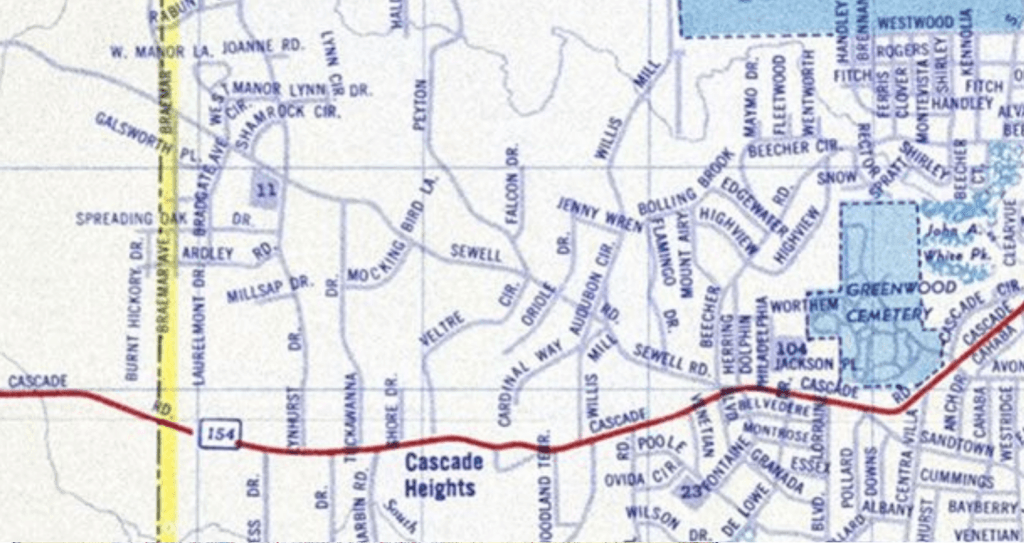
Hoke E. Morgan eventually ceased building operations in Atlanta. He died in 1985 and is buried in Volusia County, Florida. However, in the 1950s, his operational vision was fully realized in Southwest Atlanta. The physical footprint of his emerging enclave was captured perfectly on the 1956 Ashburn’s Atlanta City Map. This historical document provides the exact visual context of Southwest Atlanta right at the moment Morgan was breaking ground, showing the precise layout of Peyton Road, Lynhurst Drive, and Sewell Road coming together before the massive suburban boom fully filled in the gaps.
When viewed together, these historical documents offer much more than property lines and lot dimensions. They show the real-time decisions, the topographical challenges, and the meticulous revisions required to build a lasting community. The blueprints, maps, and paving contracts prove that the quiet elegance of Lynn Valley was not a happy accident, but the result of a highly intentional, decade-long feat of engineering.
Chapter 3: The Mid-Century Dream
With the roads paved and the valley floor leveled, the raw dirt of Southwest Atlanta was ready to be transformed into a residential showcase. Hoke E. Morgan did not set out to build a standard, mass-produced subdivision. From the very beginning, the marketing and architecture of Lynn Valley were designed to attract a discerning buyer looking for a custom, upmarket lifestyle.
The earliest advertisements from July 1953 invited prospective buyers to “Lynhurst Manor,” offering choice building lots of approximately one acre priced at $2,750 and up. By 1958, as development pushed deeper into the newly paved loop, Morgan began heavily marketing the “Valley Section.” He launched a blitz of advertisements in the Atlanta Journal, announcing “First Time Shown” open houses for newly completed properties. By April 1962, the remaining empty parcels were being sold off as “4 NICE LOTS Lynn Valley” for exactly $3,400 each.
These primary sources prove the bespoke nature of the neighborhood. An October 1958 advertisement for a home on Lynn Valley Road noted that the house was “FRAMED up and just right to buy to be finished with your selections.” Buyers were not just purchasing a finished product. They were walking through the wooden skeletons of their future homes and choosing their own premium finishes. The marketing highlighted high-end materials, boasting of “Antique Brick” exteriors and formal living and dining rooms finished in “Western Cedar” and pine paneling.
The architecture of the street was defined by the classic 1950s brick ranch, but the rolling topography of the valley gave these homes a unique advantage. Because the lots sloped, builders were able to include expansive daylight basements. These lower levels were not dark cellars, but bright, livable spaces. An October 1961 ad for a property on the street explicitly asked buyers, “Do You Have Inlaws?” boasting that the home featured 8 rooms, 2 kitchens, and a fully remodeled lower level.
While the brick ranch was the standard, the neighborhood maintained architectural variety. An advertisement for another Lynn Valley residence, built by the Flynn Brothers, specifically marketed a “NEW OLD-SOUTH COLONIAL BRICK” featuring a powder room, a 30-foot sunken family room with a massive masonry fireplace, and a rear-facing double garage. The presence of the Flynn Brothers shows that while Morgan was the primary developer, other custom builders were also leaving their mark on the street. Meanwhile, a February 1960 ad for a different property dubbed it a “SNOW WHITE BUNGALOW,” and an August 1962 ad for a neighboring home highlighted its “red Roman brick.”
The physical platting of the subdivision prioritized the allocation of vast amounts of land per household. The lots within the development averaged between 0.54 and 0.68 acres. Morgan elevated the standard suburban typology by insisting on high-quality masonry, specifically utilizing brick construction for the exterior load-bearing and veneer walls. In the context of the humid, subtropical climate of Atlanta, the choice of brick was highly functional, offering superior thermal mass for insulation against the brutal southern summers and providing absolute resistance to the rot, mildew, and subterranean termites that routinely devastated cheaper wood-sided tract homes. The interior living space expanded into massive family layouts ranging from 1,600 to over 2,700 square feet. A notable and highly functional design feature recurrent in Morgan’s architectural footprint was the seamless integration of the carport, such as the massive 420-square-foot carport featured at a Lynn Valley Road property.
The prestige of these amenities was reflected in the climbing real estate values. In the late 1950s, the original homes were priced in the low twenty thousands, with Fred A. Landers Realty listing new builds between $23,500 and $24,500. The wealth of the initial white buyers was substantial; in 1954, Audubon Forest developer George L. Wilson publicly boasted that fifty percent of the sales in his subdivision were “cash, to top-flight executives.” Yet, the classified ads also offer a fascinating glimpse into the financial mechanics and historical realities of the era. A May 1962 ad for a home on the street offered an assumable 4.5% GI loan. For those not ready to buy, the street even offered high-end rentals, with one Lynn Valley Road property leasing for $165 a month in late 1963. The financial specifics of the era were captured perfectly in a January 1971 advertisement for a Lynn Valley Road home, which offered buyers the chance to assume the loan for $7,500 down, with monthly notes of exactly $198 a month including taxes and insurance.
Residents didn’t have to go downtown; they had their own bespoke commercial hub right at the top of the hill at the intersection of Cascade and Sewell, featuring the Cascade Heights Pharmacy, Knox Jewelers, Stanley’s Shoe Repair, and the Cascade Heights Beauty Salon. For larger needs, they flocked to the massive Sears West End on Gordon Street, which boasted a new three-deck parking building accommodating 4,000 cars daily, or purchased supplies for their massive lawns at Hastings’ Garden Store.
The transition of these Lynn Valley homes occurred alongside a massive, historic housing boom for the Black elite happening just a few streets over. While Lynn Valley was defined by upscale, developer-built ranches, the broader Cascade and Collier Heights corridors were simultaneously becoming a canvas for pioneering African American architects like J.W. Robinson. Denied an architectural license for years by the state of Georgia due to his race, Robinson eventually went into full-time practice, designing stunning custom homes for the city’s Black upper class. The construction of these nearby neighborhoods was inextricably linked to the turbulent timeline of the 1960s. Just north of Lynn Valley, Juanita Abernathy was mulling over floor plans with Robinson for her new home while her husband, the Reverend Ralph David Abernathy, was sitting in a Birmingham jail cell alongside Dr. Martin Luther King Jr. Nearby, legendary Black contractor Herman J. Russell was moving into his own custom-built home on November 22, 1963, flipping on the television in his brand-new den just in time to watch the coverage of the assassination of President John F. Kennedy. The mid-century dream of Southwest Atlanta was unfolding against the backdrop of profound national upheaval.
Inside, the Lynn Valley homes were outfitted with the absolute height of mid-century luxury. Morgan proudly advertised “All GE electric appliances” and built-in vanities. This was heavily subsidized by utility companies like Georgia Power, which ran advertisements offering to pay up to $180 toward wiring homes to “Go Total Electric.” As the 1960s progressed, the real estate listings reveal a neighborhood that continued to embrace cutting-edge residential technology. Homes were marketed with central air conditioning, wall-to-wall carpeting, and automatic two-car garage door openers. Some properties even boasted built-in vacuum systems and whole-house intercoms. The home of one resident was marketed in the summer of 1960 with the ultimate upscale hook: “OPEN 3 ‘TIL 7 To Connoisseurs of Fine Living,” highlighting its “turnaround carport” and sliding glass doors.
Beyond the high-end architecture, the street pulsed with the everyday social energy of a growing suburban enclave. Adding a fun slice of life to the historical record, a Lynn Valley resident won a set of four U.S. Royal Master tires at the highly publicized Gordy Tire West End Branch grand opening in August 1959. The insulated, idyllic mid-century suburban life was in full swing. White teenagers attended the Mistletoe Ball and Sweetheart Dance at Southwest High School, while residents like Bob Nolan, co-owner of the new Ragan-Nolan Furniture Company, settled into homes like 3079 Lynn Drive, completely oblivious to the racial tensions simmering just beyond their pristine lawns.
While vintage advertisements touted assumable loans, the reality of financing homes for Black buyers across the city was far more complex. Because white-controlled banks frequently refused to underwrite mortgages in transitioning neighborhoods, Black buyers relied on a dual economy. On the formal side, institutions like the Atlanta Life Insurance Company, guided by Jesse Hill Jr., expanded their mortgage programs to open doors that white banks kept shut. The Black real estate agents facilitating these transactions took immense personal and professional risks. To protect themselves from retaliatory lawsuits and licensing trials, the Empire Real Estate Board required its brokers to contribute five percent of their commissions from these specific sales into a dedicated emergency war chest.
On the informal side, the broader West Side’s prosperity was quietly buoyed by the underground economy. The “Bug,” Atlanta’s illegal three-digit lottery, kept cash circulating through the community. Pennies and nickels passed hand-to-hand in barbershops and kitchens, with runners carrying slips and dream books to local stands. Legendary figures like Wesley Merritt, known as “Chicken Man,” spun their underground winnings into legitimate real estate across the city. Documentary proof of this era survives in the Fulton County Daily Report, which recorded Wesley Merritt actively buying real estate on Center Hill Avenue in October 1962. This whisper economy, pulsing alongside the neon glow of local establishments like The Blue Flame club, provided a crucial safety net, filling in the financial gaps and proving that wealth and stability could be forged even in the face of systemic exclusion.
By the fall of 1962, the real estate market in the area was reaching a fever pitch as racial tensions began to simmer nearby. A massive country lot, 100×300, on Lynn Valley Road was heavily marketed as a “BUILDER’S SPECIAL” for $21,750. The urgency of these late-1962 advertisements foreshadowed the dramatic collision between the mid-century suburban dream and the civil rights movement that was about to unfold right at the neighborhood’s edge.
But perhaps no real estate listing captured the turbulence of the era quite like a dramatic August 1961 advertisement for a Lynn Valley home. As Cold War tensions flared globally, the ad urged buyers to act fast, noting: “Owner being drafted, must sell immediately. Assume loan.”
Through these vintage advertisements and real estate listings, the physical reality of the mid-century dream comes to life. Lynn Valley was built to be a modern, comfortable, and highly customized sanctuary. The brick ranches, the daylight basements, and the modern electric kitchens provided the perfect stage for the vibrant, deeply connected community that was about to call this quiet loop home.
Chapter 4: The Barricade Next Door
As the 1950s gave way to the 1960s, the quiet suburban isolation of Lynn Valley collided with a rapidly changing city. The municipal identity of the area had only recently been solidified; white residents of the Cascade area first attempted to annex themselves into the City of Atlanta in 1947, but the measure was defeated by the Board of Aldermen. The area did not officially become part of the City of Atlanta until the massive 1952 annexation, a political victory born from the 1950 “Plan of Improvement” campaign heavily championed by local West End politicians to lighten the Fulton County tax burden. By the early 1960s, Southwest Atlanta was becoming the focal point of a profound demographic shift, but this transition was not merely a matter of chance. It was the result of a brilliant, highly coordinated strategy by Black leaders to break the stranglehold of Jim Crow housing. For decades, upwardly mobile Black professionals had been confined to overcrowded sections of the city due to strict segregationist zoning and redlining. In response, leaders like Robert Thompson, the housing secretary for the Atlanta Urban League, helped launch a covert initiative known as Project X. A coalition of Black investors began quietly purchasing thousands of acres of undeveloped land just outside the city limits on the west side. Instead of building isolated pockets, they utilized a military-style pincer movement, buying land that deliberately encircled existing white suburbs. By leveraging the white establishment’s own racial fears, they knew white homeowners would eventually sell, opening up the spacious lots and modern amenities of the Cascade corridor to Black buyers. The transition of these neighborhoods was inevitable, but the resistance from the white establishment would physically scar the landscape just steps from Lynn Valley Road.
To understand the shock of what happened next, one must look at how interconnected these streets originally were. In the late 1950s and early 1960s, real estate advertisements for “Lynn Acres” actively directed prospective buyers to use Peyton Road as a primary access artery. A June 4, 1961, advertisement for a 7-room brick home on Lynn Valley Road explicitly instructed buyers to navigate the area by taking a “turn Rt on Peyton Rd., turn left on private street.” The two neighborhoods were seamlessly linked, sharing the same rolling topography and quiet woodland appeal.
That seamless connection was violently severed in December 1962. When pioneering Black professionals began purchasing homes in the adjacent white Peyton Forest subdivision, racial tension reached a boiling point. Peyton Forest was an idyllic new development where the streets were named after English literary figures like Chaucer, Shelley, Keats, and Fielding. The residents were solidly middle-class, mostly salesmen and office managers, alongside a contingent of Army officers and government employees.
The crisis was actually triggered by the subdivision’s own developer, F.E. Bennett, who lived in a large home on Fielding Lane complete with a horse barn and a racing track. Financially strapped and unable to find white buyers for his properties, Bennett accidentally sparked the neighborhood panic on June 11, 1962. While trying to call Calhoun Realty to handle a transaction, he misdialed and accidentally left his information with Calloway Realty, a Black firm owned by W.L. Calloway.
When Calloway and two of his salesmen, Jewell and Ed Billingsley, showed up at Bennett’s house that evening, they walked into an ambush. A shocked Bennett had immediately called his white neighbors, including Virgil Copeland, president of the Southwest Citizens Association, who rushed over to confront the Black realtors in Bennett’s living room. What followed was a tense, forty-five-minute standoff. The white residents demanded to know their intentions, accusing them of soliciting in a white neighborhood. The Black realtors refused to back down. They calmly handed out their business cards, cited statistics on the severe ratio of the Black population to available housing, and firmly defended their ethical right to sell real estate to anyone, anywhere. The Peyton Forest racial panic officially began right there in Bennett’s living room.
Panic swept through the white establishment, and the resistance was visceral and deeply documented. The exact mechanics of the blockbusting tactics that fueled this panic were captured in the raw evidence mailed to the Mayor’s office. The Adams Real Estate Company blanketed the neighborhood with letters stating: “You want a fast sale, at top market price, with no inconvenience to you, don’t you? If so please list your property… with us.” White residents forwarded these to the Mayor, noting angrily that dozens had been received. Affidavits from white homeowners complained of getting phone calls from realtors explicitly telling them they already had listings for colored buyers and that the neighborhood was “definitely ‘going colored’.” The psychological warfare was relentless; realtors would tell white homeowners that an out-of-town owner had already sold to a Black family, and then whisper around the neighborhood, “they are coming.” In November 1962, the local press explicitly named Lynn Valley alongside Audubon Forest and Peyton Forest as the specific neighborhoods where racial tension was rising due to these blockbusting efforts.
In adjacent neighborhoods, white civic clubs circulated urgent letters warning residents, “REMEMBER THAT COLORED CANNOT BUY UNLESS THE WHITE MAN SELLS.” When polled about integration, bitter white homeowners scrawled angry notes in the margins of their ballots, with one declaring, “I won’t stay here and be surrounded by negroes regardless of any decision.” This fierce resistance highlighted a unique dynamic in Southwest Atlanta’s development. While nearby enclaves like Collier Heights were being built from scratch specifically by and for Black residents, the Cascade corridor and Lynn Valley were transitioned neighborhoods. Outspoken Black leaders like State Representative Billy McKinney would later proudly contrast the custom-built Black suburbs with the transitioned streets of the Cascade area, playfully dismissing the latter as “hand-me-downs.” Yet, for the upwardly mobile Black professionals claiming the mid-century ranches of Lynn Valley, these homes were hard-won victories on the front lines of integration.
The Southwest Citizens Association hastily amassed a $200,000 war chest in a desperate bid to buy Bennett’s land back. They formed a legal corporation called “Southwest, Incorporated,” actively selling stock to white residents to pool money to purchase threatened homes. Their financial desperation was profound. When Phoenix, Inc. moved to foreclose on Bennett’s fifteen vacant lots, Virgil Copeland wrote a frantic letter to Mayor Ivan Allen Jr. on February 16, 1963, begging the Mayor to use his political weight to force the bank to delay the foreclosure by a month so the white citizens could raise the funds to keep the land out of Black hands.
Meanwhile, a frantic bidding war erupted over Bennett’s own home. By November 1962, Bennett had a contract to sell his house to Dr. Clinton Ellsworth Warner, a Black physician, for $65,000. The city establishment panicked. A confidential memo from December 20, 1962, reveals that Mayor Allen and city officials actually tried to pressure Dr. Warner to “relinquish his contract” and let the white neighbors buy it back, asking the physician to make a “voluntary sacrifice” to appease the white residents. Dr. Warner refused and moved in anyway.
To quietly bypass the white blockade on his other properties, Bennett used his family in a real estate shell game. He transferred a property at 579 Fielding Lane to his brother-in-law, T. David Trammell, who then sold it to a Black buyer. The mortgages for these properties were quietly assumed by a newly formed corporate entity named WITHCA, Inc. Incorporated on March 7, 1963, the name “WITHCA” was actually a secret acronym representing the three Black real estate titans who formed it: WIlliamson (Q.V. Williamson), THornton (C.C. Thornton), and CAlloway (W.L. Calloway).
Seeking municipal intervention, white residents turned to their local representatives. Alderman Milton G. Farris first attempted to halt the encroachment by sponsoring an ordinance to dead-end Willis Mill Road, leaving over one hundred acres of undeveloped land as a buffer to cut off Black residential expansion into Cascade Heights. When that failed, Farris and Alderman Jack Summers proposed building a 75-acre “Negro cemetery” directly between the white and Black neighborhoods to act as a permanent racial barrier. Black realtist Q.V. Williamson and the Empire Real Estate Board swiftly killed the idea, sending a strongly worded telegram to Mayor Allen pointing out the obvious reality that Black buyers needed living space, not burial space, and would merely jump the buffer to continue building homes.
With the cemetery plan discarded, the city turned to a drastic backup plan. The historical irony of the location was staggering. Almost exactly a century earlier, in August 1864, Union troops had marched down Peyton Road to break the Confederate lines at Utoy Creek. Now, in 1962, the white establishment in Southwest Atlanta sought to draw a new line on that exact same soil. For a decade prior, white civic groups had successfully lobbied the city to use municipal infrastructure as a racial weapon, negotiating for a massive six-lane highway, a 500-unit white-only public housing project, and strategic industrial zoning around the West End and Cascade area to act as an unbroken line of barriers against Black expansion. Documentary proof of this strategy surfaced in January 1952, when Fulton County announced a million-dollar plan to develop a 4,000-acre industrial zone bordering the river in West End.
The idea for the barricades was dictated to the city by the white residents months in advance. On September 11, 1962, the white Citizens of Peyton-Utoy Forest Community submitted a formal “Proposed Community Stabilization Plan” to Mayor Allen. The proposal offered to concede 250 acres of land north of Utoy Creek for 400 Negro residences in exchange for the city permanently dead-ending Peyton and Harlan Roads to create a physical buffer. The city followed the neighborhood’s blueprint. The segregationists were deeply entrenched in “respectable” civic life; Alderman Milton Farris, who proposed the cemetery buffer and led the charge for the barricades, had been named “Trustee of the Year” for the Library Board in 1951. The Southwest Citizens Association even held their massive December 1962 strategy meeting to discuss the “block-busting threat” inside the gymnasium of Southwest High School, using the taxpayer-funded public school as their headquarters.
In an attempt to halt integration and appease white residents, the city government under Mayor Ivan Allen Jr. took unprecedented action. The betrayal stung the Black community deeply, as Mayor Allen had just won the 1961 mayoral election against Lester Maddox, an epic racist, with the solid support of Black voters. On December 17, 1962, the city council approved legislation to erect physical barricades across Peyton and Harlan Roads. There was only one “no” vote cast that day, by Alderman Richard Freeman, who questioned the legality of the entire scheme. The next morning, on December 18, city crews erected a three-foot-tall barricade.
The physical reality of the barricade was stark. Erected near the intersection of Peyton Road and Martin Luther King Jr. Drive (then Gordon Road), just steps from the Gordon Plaza Shopping Center, and on Harlan Road just before the intersection with Tee Street, it consisted of heavy wooden beams painted black and white, bolted securely to heavy steel I-beams, and sunk directly into the pavement. Because the city knew it could not legally barricade private property, the structures were placed exactly one inch inside the city’s property line, complete with municipal “Road Closed” signs. White residents celebrated the obstruction with profound enthusiasm; residents of Peyton Forest were reported to have wrapped the barricade in festive Christmas paper and hung a large sign that declared, “Thank the Lord!”
The barricade was immediately dubbed the “Atlanta Berlin Wall” by legendary civil rights attorney Donald Hollowell during a December 14 hearing, where he explicitly charged the city with trying to create a “racial buffer.” For the residents of Lynn Valley, the wall was not an abstract political debate happening downtown. It was a literal roadblock in their own backyard. The barricade severed the very access routes that realtors had used to sell the neighborhood just 18 months prior.
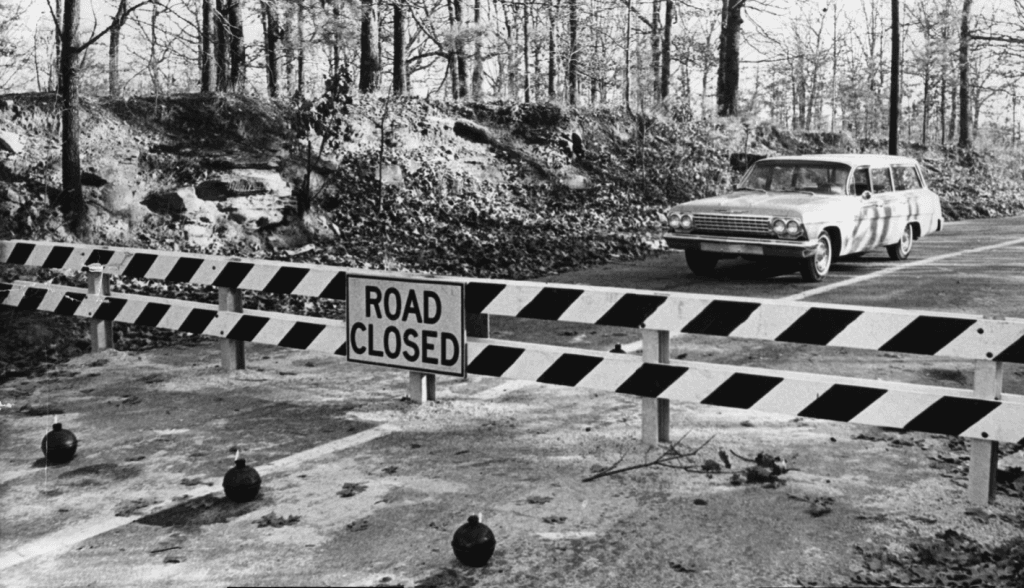
Protests erupted immediately, and the escalation was meticulously documented day by day. Civil rights organizations picketed City Hall, and prominent leaders like Martin Luther King Sr. publicly condemned the structure as a grave mistake. Student leader Ralph Moore sent a telegram to Mayor Allen threatening to unleash 175 picketers a day and stage mass demonstrations featuring 1,500 students directly at the wall. The Black community also wielded a massive financial weapon. In early 1963, the city was attempting to pass a $55 million joint city-county bond issue to fund critical infrastructure. The Atlanta Inquirer reported that Black civic and social clubs were organizing to vote down the entire $55 million package if the Peyton buffer and hotel segregation were not resolved, literally holding the city’s financial future hostage over the barricades.
Mayor Allen desperately tried to form a “biracial committee” to negotiate an 18-month freeze on Black families moving south of the barricades. However, Dr. C. Miles Smith, president of the Atlanta branch of the NAACP, led the newly formed All-Citizens Committee in an iron-clad boycott. The Black leadership presented a unified front, flat-out refusing to appoint anyone to the Mayor’s committee or negotiate a single word until the physical barricades were torn down. Internal memos show Mayor Allen’s deep frustration, drafting letters calling their refusal “arbitrary” and “deeply regretable.”
This uncompromising stance was fueled by intense grassroots pressure. A January 11, 1963, memo reveals that legendary white R&B radio DJ Zenas Sears was using his massive platform on WAOK radio to agitate the Black community against the barricades. Conservative Black leaders complained to the Mayor’s office that Sears was trying to “destroy the established leadership,” forcing the older generation of civil rights figures to hold a militant line rather than compromise. The defiant Black press amplified this stance. Q.V. Williamson delivered a blistering quote regarding the Mayor’s attempt to bypass their unified coalition: “The time has past when the Negro will allow someone else to determine who will represent him.” Dr. C. Miles Smith made a direct, public threat to the Mayor’s political survival, stating: “If the Mayor leaves the barriers up, they will be there to remind the 40,000 Negro voters in Atlanta at election time.”
The rhetoric reached a fever pitch at the New Year’s Day Emancipation Proclamation celebration in 1963. Attorney D.L. Hollowell used the historical anniversary to publicly roast the city administration: “I can’t understand how the Aldermanic Board and the Mayor in ‘Amazing’ Atlanta, 100 years after the Emancipation Proclamation, could have the audacity, or gall, to put a barrier across Peyton Road.” Rev. Samuel W. Williams added to the fire, stating: “Perhaps we need to send Mayor Allen a copy of the Emancipation Proclamation.”
The Mayor’s office was flooded with mail from across the country expressing shock at the barricades. But perhaps no letter captured the international embarrassment quite like a brilliantly sarcastic note sent on January 31, 1963, by Bruce C. Barthel and William J. Apsit of Cambridge, Massachusetts. They wrote to “congratulate” the Mayor on his unique method for furthering integration: “Just as Khrushchev forwarded freedom by allying the freedom-loving peoples against his wall… you, Mayor Allen, have forwarded integration by allying the Negro and White peoples of Atlanta against your wall.”
The situation grew incredibly volatile and dangerous. On December 24, 1962, a vacant house located on Peyton Road, sitting about a half-mile inside the buffer zone, was intentionally set on fire in an act of arson. Despite this, unknown individuals took direct action: the Peyton Wall was sawn into pieces, the heavy steel I-beams were violently pulled from the asphalt, and the debris was discarded in a nearby creek. The following day, desperate white residents hastily improvised a new barricade out of the remaining scraps, local brush, felled trees, and heavy stones. That makeshift barrier was deliberately set on fire the same night.
The buffer zone was definitively broken in late February 1963 when Robert A. Bright, a white homeowner at 427 Peyton Road, broke ranks and sold his house to Black realtor C.C. Thornton. The retaliation was swift and exposed a stunning level of political hypocrisy. On February 25, 1963, four uniformed Klansmen, including prominent Grand Dragon Calvin Craig, picketed Bright’s home. However, police reports reveal a fascinating divide between the overt terrorists and the “respectable” racists: Virgil Copeland actually went to the Klan spokesman and asked them to leave because he was “afraid the klan picketing may hurt his cause.”
Instead of burning crosses, the white civic leaders attempted to weaponize the legal system. A confidential police report reveals that Virgil Copeland, accompanied by ‘Mr. Sam Massell, of the Southwest Citizens [Association]’—indicating the segregationist group had retained veteran Atlanta attorney Samuel Massell Sr. as their legal muscle—went to Robert Bright’s home to pressure the terrified white homeowner into backing out of the sale. Separately, Copeland and the white citizens group plotted with a local judge to force Bright to sign an affidavit claiming Thornton used illegal threats, with the explicit goal of getting the Georgia Real Estate Commission to permanently revoke the Black realtor’s license and destroy his livelihood. The white group was also preparing to go to a Grand Jury to criminally indict Cecil Turner, the white real estate agent who had represented Bennett, claiming he was in “collusion” with the Black real estate board.
Terrified by the pressure from the Vice-Mayor and the civic club, Bright actually rescinded his offer to Thornton and agreed in writing to sell his house back to the white citizens group. However, the white group’s lawyers reviewed the contract and realized they had a “very weak case” to legally break the original sale. Thornton kept the house, and the buffer was permanently broken. Mayor Ivan Allen Jr., despite his later reputation as a civil rights icon, went on the record with the Atlanta Inquirer calling the sale to the Black buyer “regrettable.”
Behind closed doors, the white segregationist leadership was fracturing. Sid Avery, the former president of the Southwest Citizens Association who had been hired by the city as its Housing Coordinator, began secretly calling the Mayor’s office to backstab his successor. Avery told the Mayor he had “chosen the wrong person” to negotiate with and that Copeland “did not represent the feelings of the group,” pitching his own schemes to save face as their defense collapsed. Black leaders knew exactly who they were dealing with; J.T. Bickers, the outgoing president of the Empire Real Estate Board, publicly accused Avery of masterminding the barricades, declaring to the press, “He instigated the whole mess… It started over a year ago in his office.”
However, the ultimate defeat of the barricades did not come solely from the streets; it came from the exact same brilliant real estate strategies that Black leaders had been perfecting on the west side for a decade. Utilizing the leapfrog tactics of the Project X era, Black real estate professionals realized that Lynn Valley Road and Lynn Circle ran parallel to Peyton Road, sitting just behind the barricades. In early January 1963, the Atlanta Journal reported that Black buyers had launched a strategic “flank attack” by purchasing three homes on Lynhurst Drive, the main artery into Lynn Valley.
This flank attack was actually a brilliant psychological bluff. When the rumor hit the papers, the white Southwest Citizens Association panicked. Virgil Copeland later revealed they literally went door-to-door on Lynhurst Drive, from Cascade to Gordon, forcing every single white resident to sign a sworn legal affidavit proving they hadn’t sold to a Black buyer. The Black realtors had successfully weaponized the white residents’ own paranoia against them, forcing them to spend their time policing their own neighbors. By entering the neighborhood through this corridor, they bypassed the barricades entirely, executing a flawless pincer move that rendered the physical wall useless.
The international embarrassment and intense legal pressure proved too much for the city to sustain. The wall stood for just 72 days. The official lawsuit that struck down the barricades was L.K. Googer, et al., vs. City of Atlanta. Judge George P. Whitman Sr. of the Fulton Superior Court issued his ruling on March 1, 1963, officially ordering the city to remove the barricades. The judge systematically dismantled the City’s defense, noting that municipal traffic laws could not be used to enforce racial segregation, declaring the barricades “unreasonable, arbitrary and capricious.”
But the lawsuit carried a profound, stunning irony. The plaintiffs who successfully sued the City of Atlanta to tear down the racial barrier were not Black civil rights leaders. L.K. Googer and Harold Johnson were residents who lived on Harlan Road just north of the barricades. The wall had inconvenienced their daily commute so badly that they sued their own city to have it removed as a “public nuisance.”
The fall of the Peyton Road Wall was a watershed moment for Southwest Atlanta. Rather than halting integration, the highly publicized ordeal only accelerated the demographic shift of the corridor. By the end of July 1963, less than six months after the barricade’s destruction, all but fifteen white families had abandoned the Peyton Forest, Lynhurst, and Lynn Valley neighborhoods entirely. Segregationist leaders like Virgil Copeland resigned in total defeat by April 1963, admitting to the press: “When the barricades came down, everything collapsed.”
In their defeat, the white residents enacted a spiteful, multi-million dollar revenge plot. Having lost the wall, Copeland and the Southwest Citizens Association deliberately boycotted the Empire Real Estate Board, refusing to give their listings to the Black realtors who had fought the barricades. Instead, they gave exclusive rights to sell thirty of their homes to Curtis Clark, a Black realtor who had supported the segregationist plan to build a “Negro cemetery” as a racial buffer. The white segregationists weaponized their own white flight to financially reward a Black collaborator and punish the civil rights realtors who had defeated them.
The philosophical divide underlying the entire conflict was perfectly summarized by Mayor Ivan Allen Jr. during a meeting with city business leaders. “The white community as a whole tends to define racial harmony as the absence of disturbance,” the mayor noted. “The Negro community, to a man, defines it as the establishment of their full rights as American citizens.” With the physical barriers removed, the path was cleared for a new generation of Black excellence to claim the mid-century ranches of Lynn Valley.
Chapter 5: Integrating the Anchors
The removal of the physical barricade on Peyton Road allowed Black families to purchase homes in the mid-century ranches of Lynn Valley, but the fight for true equality was only just beginning. While the streets were opening up, the foundational institutions that anchored the neighborhood remained strictly segregated. For the new residents, the most glaring injustice was not just housing, but education.
The geographic absurdity of segregated schooling was felt deeply by the families living in the valley. Black parents were paying taxes to support pristine, newly built facilities like West Manor Elementary and Southwest High School, yet their children were barred from walking through the doors. Instead, students like Phyllis Jackson Smith experienced the heavy burden of inequality firsthand. She recalled having to board a bus and ride more than seven miles to an all-Black school, watching white children from her own neighborhood take a short, easy walk to the state-of-the-art high school right down the street.
The Black residents of Southwest Atlanta refused to accept this inequity. Her father, Leonard Jackson, became a plaintiff in the landmark Calhoun school desegregation case. Brought forward by the NAACP in 1958, the lawsuit directly challenged the segregated educational system of Atlanta. Following a federal court order, the city was forced to begin a slow, grade-by-grade integration process.
The hostility the Southwest Seven faced was foreshadowed fourteen years earlier. In September 1950, the local press published a vicious editorial titled “Race Baiting by Negroes,” explicitly attacking Thurgood Marshall and the NAACP for attempting to force the “mingling of white and Negro children in the Atlanta Public Schools,” proving the deep-seated resistance that had been brewing for over a decade.
The demographic shift of the neighborhood was swift and undeniable, driven by highly affluent Black professionals seeking the mid-century dream. Records show Dr. Roy Hunter Jr. was already residing on Lynn Valley Road by early 1963. Given the precise timing of his arrival, it is highly probable that his home was one of the purchases in the strategic “flank attack” that bypassed the barricades. At the very least, his purchase was part of that immediate, brave wave, making him one of the very first Black pioneers to move into the neighborhood right as the Peyton Road Wall crisis was concluding. (His wife, Julie, whom he married in 1966, would also become a formidable presence in the neighborhood.)
On December 18, 1964, the Atlanta Journal published a landmark article titled “$40,000 Sewell Home Sold to Negro Doctor,” detailing the purchase of a home by Dr. J.L. Geiger. The white seller, F.N. Roberts, admitted to the press that it was “inevitable that Negro ownership spread in that direction.” The irony was profound: in 1952, Roberts had served as the co-chairman of the Southwest Citizens Committee, leading the very charge to stop Black residents from moving into the area. Twelve years later, he was handing over the keys to a Black physician. The press coverage, utilizing the standard journalistic terminology of the era, explicitly confirmed the rapid transition of the immediate area, reporting that “Negroes also have bought homes on several other streets in Cascade Heights, Ivan Hill Drive and Lynn Valley Circle among them.”
This profound irony extended to Ernest A. Sewell. He passed away in November 1958, and his funeral was held at the very West Manor Baptist Church he had helped bring to the community. He had previously lived in a home on Lynhurst Drive, but by the time of his death, he had moved to Sewell Road, and classified advertisements reveal his former Lynhurst residence was being leased out as a modest rental bungalow. By early 1965, real estate listings showed his former residence was officially on the market. That summer, the home was purchased by Dr. Lee R. Shelton, a Black physician on the staff of Holy Family Hospital, and his wife. The hospital itself was a recent and vital addition to the corridor; its sixty-acre site was announced in the Atlanta Daily World in 1962 and opened in 1964 with dedicated maternity capacity. Their arrival, however, was met with targeted harassment. In August 1965, the Atlanta Journal reported that the Sheltons awoke to find their newly purchased home maliciously vandalized by white painters who had covered the front steps and equipment in paint. The perpetrators claimed they had been hired by telephone to redecorate the house, a thinly veiled act of racial intimidation. Yet, despite these cowardly tactics, the Sheltons remained, and the transition of the corridor continued unabated.
In the fall of 1964, the doors of Southwest High School finally opened to Black students. Phyllis Jackson Smith and six of her peers, forever remembered as the Southwest Seven, bravely integrated the campus. Their arrival was met with intense hostility. The daily experiences of the Southwest Seven were harrowing, requiring immense psychological resilience against relentless, unchecked abuse. In the cafeteria, where the Black students were frequently isolated, white students would hurl food and spit on them. The hostility extended to the school’s transportation network; white school bus drivers would intentionally close the pneumatic doors in the faces of the Black teenagers and drive away, forcing them to find alternate, often dangerous routes to their homes in the Southwest enclaves.
The violence occasionally escalated to physical assault. In one severe incident during a Glee Club meeting, a white student violently threw an object that struck Jackson Smith directly in the forehead, drawing blood. The white teacher presiding over the club pointedly ignored the assault, refusing to intervene or offer medical assistance, an act of complicity that prompted a sympathetic white female student to scream in outrage at the teacher’s deliberate negligence.
Yet, despite these horrific, daily degradations, the students immediately recognized the stark disparities in the segregated system, noting that the white high school possessed vastly superior facilities and much better textbooks than the schools they had previously been forced to attend.
Despite the initial hostility, the demographic shift was unstoppable. Principal Claude C. Wills Jr. documented the swift change, noting that the Black student population at Southwest High leaped from just 25 students in the 1965 to 1966 school year to 230 the following year. Wills publicly admitted that the transition was not entirely peaceful, acknowledging racial incidents with white boys fighting Negro boys. However, moments of profound cooperation eventually emerged. By the 1967 to 1968 school year, the student body was nearly evenly split. A May 1968 article penned by students proudly declared that Southwest High had “achieved unity,” noting that the integrated student council and cheerleaders worked together to improve campus conditions, even successfully securing the parking lot of the neighboring West Manor Baptist Church for student use.
The integration of the local schools triggered a rapid and dramatic demographic transition across the Cascade corridor. With the end of legal housing segregation, the Black population began to decentralize. While Black residents increased throughout the MSA, the growth was concentrated largely in areas adjacent to existing concentrations of Black neighborhoods, namely south DeKalb County and south Fulton County. As Black families proudly claimed their rightful place in the neighborhood classrooms, white flight accelerated at a staggering pace. As white families fled, the result was a dynamic where more than 71 percent of the region’s Black population became located in the southern half of the metro area. The transformation was meticulously documented in local news reports. By October 1969, West Manor Elementary Principal Glenn Harkins noted that out of a student body of five hundred pupils, only ten white students remained.
The rapid transition brought significant growing pains to the neighborhood. In July 1970, the West Manor Elementary School Concerned Parents protested the school board over severe overcrowding and the use of portable classrooms. Yet, despite these logistical challenges, the community spirit thrived. In November 1972, the newly integrated West Manor Elementary choir sang at the lighting of the Great Tree at the downtown Rich’s department store, a beautiful milestone for the community. Decades later, former students would share nostalgic memories of early educators like Jane Rodgers Moore and Miss Smith, who once invited entire classes to their homes for lunch, and warmly recall childhood days spent playing chase in the yards on nearby Braemar Avenue.
The transition was swift and often turbulent, but the Black families of Lynn Valley did not merely integrate these educational anchors. They took full ownership of them. As white flight accelerated, the demographic reality of the school system shifted entirely. By 1973, the student body was overwhelmingly Black, rendering traditional integration methods like cross-town busing highly impractical. Recognizing this reality, local NAACP president Lonnie King and Black leaders brokered the historic Atlanta Compromise. In a highly controversial but pragmatic trade that defied the national NAACP, local leaders agreed to limit massive busing in exchange for sweeping administrative control, ensuring Black leadership in the superintendent’s office and top executive roles. Through immense bravery and unwavering civic determination, residents transformed these once-segregated buildings into proud pillars of Black educational excellence, ensuring that the schools would serve and uplift their community for generations to come.
Chapter 6: A Giant Among Neighbors
As the demographic shift of the 1960s transformed Lynn Valley into a premier enclave for Black professionals, the street attracted individuals of profound historical significance. Among the educators, entrepreneurs, and civic leaders who purchased homes under the mature forest canopy was a man whose quiet demeanor belied his status as a towering figure in American history. At a home on Lynn Valley Road lived Heman Marion Sweatt, a civil rights pioneer whose courage fundamentally altered the trajectory of the nation.
Long before he settled into the peaceful mid-century ranches of Southwest Atlanta, Sweatt was forging a path of excellence and activism in Texas. Born in Houston in 1912, he was instilled with a deep reverence for education by his father, a former principal and founding member of the local NAACP chapter. Sweatt attended Wiley College in Marshall, Texas, graduating in 1934. Regarded as one of the most brilliant students on campus, he was mentored by the legendary professor Melvin B. Tolson, who encouraged his students to actively challenge racial discrimination.
Sweatt carried that ethos into his early career. While working as a postal carrier in Houston, he served as the local secretary of the National Alliance of Postal Employees, actively challenging the discriminatory practices that systematically excluded Black workers from supervisory roles. His commitment to justice soon placed him at the center of a monumental legal battle. In 1946, Sweatt applied for admission to the University of Texas Law School but was denied solely because he was Black.
In a desperate bid to circumvent integration and satisfy the “separate but equal” mandate, the state of Texas attempted to hastily establish a makeshift, unaccredited “law school” for Black students. State officials rented a small basement in Houston containing merely three classrooms and absolutely no library, hiring two African American lawyers to serve as the entire faculty. Sweatt courageously refused this glaringly unequal, humiliating accommodation. Backed by the NAACP Legal Defense Fund, he took his fight to the courts.
His legal battle culminated in the landmark 1950 United States Supreme Court case Sweatt v. Painter. The unanimous ruling successfully challenged the “separate but equal” doctrine, forcing the integration of the law school and serving as the direct legal predecessor to the monumental Brown v. Board of Education decision four years later.
The immense stress of the protracted legal battle took a severe toll on his health, eventually leading him to withdraw from law school in 1952. However, his dedication to public service never wavered. Sweatt earned a master’s degree in community organizations from the Atlanta University Graduate School of Social Work in 1954. After a stint in Cleveland, he returned to Atlanta, dedicating twenty-three years of his life to the National Urban League. He worked tirelessly on voter registration drives and programs designed to assist southern Black migrants.
After a lifetime of intense public scrutiny and tireless advocacy, Sweatt found a quiet sanctuary in Lynn Valley. He spent his later years residing on Lynn Valley Road with his wife Katherine Gaffney and their two daughters, enjoying the secluded wooded retreat that the neighborhood provided. His presence on the street added an unparalleled layer of historical prestige to the enclave. He was not just a resident; he was a living embodiment of the very civil rights struggles that had eventually opened the doors of Southwest Atlanta to Black homeownership.
When Heman M. Sweatt passed away in October 1982, his passing was quietly noted in the death notices of the Atlanta Daily World, with arrangements handled by the local Herschel Thornton Mortuary. Yet his legacy echoed far beyond the borders of the neighborhood. Having a civil rights giant of his magnitude choose Lynn Valley as his final home perfectly cemented the status of the street. It was no longer just a collection of beautiful brick houses. It was a proud, established haven for the trailblazers who had reshaped the American landscape.
Chapter 7: The Social Swirl
From its earliest days, Lynn Valley blossomed into a vibrant epicenter of high society and deep community fellowship. The neighborhood was never just a collection of beautiful mid-century homes; it was a highly connected enclave where residents gathered to celebrate, organize, and entertain. The day-to-day lifestyle of the street was frequently chronicled in the social columns of local newspapers, painting a vivid picture of a warm and hospitable community.
Even before the demographic shifts of the mid-1960s, the street was alive with social activity. In November 1950, J.A. Morgan hosted the wedding reception for his daughter Gloria Morgan at his custom home on Sewell Road following a ceremony at Beecher Hills Baptist Church, with Mrs. H.E. Morgan and Mrs. D.M. Morgan co-hosting a pre-wedding tea for her at Rich’s department store. In December 1953, the Cascade Garden Club sponsored a “Yule Homes Tour” showcasing the area’s finest new architecture, including the homes of T.D. Mann on Sewell Road, Virgil E. Jones on Flamingo Drive, and Dewey Morgan’s Victorian-decorated ranch at 1151 Flamingo Drive. In March 1960, the Atlanta Journal noted the Powers family hosting college students for the spring holidays, and in July 1960, a “man-on-the-street” column captured the political opinions of Miss Jean Scoggins, a file clerk living on Lynn Valley Road. The neighborhood was also home to everyday celebrations, like when C.P. Jones, a resident of Lynn Valley Road, won a set of U.S. Royal Master tires in a highly publicized local contest. The street also saw its share of international high society, with residents like William and Becky Farthing of Lynn Valley Road attending exclusive receptions for the French Consul in the summer of 1965.
As the 1970s and 1980s unfolded and the neighborhood transitioned into a premier destination for Black professionals, the social energy only amplified. Because downtown hotels and restaurants remained strictly segregated during the early years of transition, the daylight basements and expansive lots of the valley provided the perfect backdrop for elegant entertaining. Residents frequently opened their well-appointed homes to host a variety of prestigious events, outfitting their lower levels with parquet dance floors and mirrored bars. The neighborhood teenagers were expected to behave at these lavish gatherings. Parents frequently hired a youthful Eldrin Bell, who would later become the Chief of the Atlanta Police Department, to chaperone the parties and ensure no one sneaked a flask into the punch bowl. These homes provided the perfect setting for major life milestones, such as the September 1973 silver anniversary celebration of Mr. and Mrs. Eddie Lomax, and the August 1979 wedding of Brenda Wynetta Walker and Morais A. Taylor. In the summer of 1979, Emory and Mary Kemp welcomed fifty guests to their home on Lynn Valley Road for a lavish pre-nuptial barbecue, utilizing their spacious backyard flower garden for the festivities.
Other homes served as gathering spaces for prominent Greek-letter organizations. Theodore and Mary Carolyn Menchan, residing on Lynn Valley Road, famously hosted elegant dinners for the Kappas and the Silhouettes, while Sharon Taylor opened her Lynn Valley home to host the official installation ceremonies and Christmas party for the Greater Atlanta Pan-Hellenic Council. The women of the neighborhood also led highly active philanthropic organizations. Mary Carolyn Menchan hosted the M.R.S. Club at her home, where members gathered canned goods to distribute to needy families. Similarly, the Otherette Club utilized the scenic back lawns of the neighborhood to host beautiful retirement luncheons and community gatherings. Just beyond the neighborhood borders, intellectual life thrived in spaces like the Florida room of Hallie Brooks, a librarian at the Atlanta University Center who hosted formal meetings of the Chautauqua Circle, the only surviving African American chapter of the historic cultural movement in Atlanta. During the holidays, the social energy transformed the entire Cascade and Collier Heights corridors into a winter wonderland. Subdivisions and community clubs engaged in fierce, elaborate Christmas decoration contests, and Lynn Valley families would frequently pile into their cars to cruise the surrounding neighborhoods, admiring the dramatically lit trees and nativity scenes that illuminated the Black enclaves of Southwest Atlanta.
The hospitality of the street extended far beyond local friends and neighbors. Lynn Valley regularly welcomed out-of-town dignitaries and national leaders. When the prestigious volunteer service organization The Links held a convention in Atlanta, resident Dorothy Stokes, who lived on Lynn Valley Road with her husband Robert, entertained visiting delegates from across the country with a beautifully catered evening at her home. These gatherings cemented the reputation of the neighborhood as a premier destination for Black professionals and civic leaders to connect and socialize.
The cultural energy of the enclave was so strong that it even produced its own musical group. The Lynn Valley Ensemble, directed by James Wallace, became a celebrated local talent. The group reached a pinnacle of local fame in February 1982 when they were invited to provide the musical selections for the massive Bronner Bros. International Beauty Show. Performing at the downtown Marriott Hotel for an audience of thousands, the ensemble showcased the immense pride and creative spirit of their Southwest Atlanta street on one of the biggest stages in the city.
Through these elegant dinners, fraternity gatherings, and musical performances, the residents of Lynn Valley wove a tight social fabric. They proved that true neighborhood prestige is not just about the architecture of the houses, but the warmth, joy, and profound connection of the people living inside them.
Chapter 8: The Power of the Community Club
The elegant social gatherings of Lynn Valley were matched only by the profound civic dedication of its residents. To protect their thriving enclave and uplift the broader city, neighbors formally organized the Lynn Valley Community Club. This organization quickly became the beating heart of the street, transforming a collection of private homes into a deeply unified and highly mobilized neighborhood.
Early newspaper records from March 1968 show the club in action, with neighbors like Dr. Roy Hunter and his wife Julie hosting meetings at their home specifically to welcome new residents. Under the guidance of early presidents like Leo Davenport, the club established a standard of deep community care, ensuring that anyone who moved onto the wooded loop immediately felt embraced by their neighbors.
The political influence of the club was undeniable. In August 1969, major political figures, including future Mayor Sam Massell and Alderman Rodney Cook, appeared before members of the Lynn Valley Civic Club on a Sunday night to discuss their mayoral campaigns. Cook was the only white city official to publicly oppose the Peyton Road Wall in 1962, a principled stand that resulted in the Ku Klux Klan burning a cross on his lawn in retaliation. His active campaigning directly in front of the club seven years later brought the political history of the neighborhood full circle, proving the organization was a recognized political powerhouse.
Beyond philanthropy, the club took a highly proactive approach to neighborhood safety and stability out of sheer necessity. The neighborhood had to remain fiercely vigilant against municipal zoning practices that threatened their borders. In the late 1960s and throughout 1970, residents and biracial coalitions successfully fought off city attempts to spot-zone parcels on Sewell Road for massive 650-unit public housing projects and high-density apartments. Civic leaders explicitly called out the city’s hypocrisy, noting that while residents were fighting to maintain a stable, integrated middle-class neighborhood, the city itself was the main force threatening to resegregate the area by dumping high-density public housing into the corridor. Such a massive influx would have overwhelmed the community and forced West Manor Elementary into double sessions.
The institutional bias the neighborhood faced was profound. In 1960, the City of Atlanta hired Sid Avery, the president of the segregationist Southwest Citizens Association, to serve as its official Housing and Relocation Coordinator. The city had literally hired the head of the neighborhood’s white defense group to mediate racial housing disputes. Avery wasn’t just a loudmouth civic club president; he was at the absolute pinnacle of white institutional power, serving as the Clerk of Session and on the Building Committee for the $550,000 Gordon Street Presbyterian Church in 1952. Furthermore, while SWAP and local residents were begging for help against blockbusting, the City of Atlanta actively rejected federal recommendations to pass protective laws. In 1967, urban planning consultants (Candeub, Fleissig & Associates) submitted a study recommending Atlanta “adopt an anti-‘block-busting’ ordinance” and “local fair housing legislation.” In a May 11, 1967 memo, the Atlanta City Planning Staff fiercely attacked the report, officially dismissing the consultants’ recommendations for fair housing laws as “vague and to some extent useless.”
A February 1967 blockbusting letter sent by Sid Stovall of Stovall Realty to induce white panic selling listed specific addresses of homes that had recently been sold to Black buyers. One of the addresses explicitly listed to scare white homeowners was “700 Lynn Circle.” Because Lynn Circle connects directly to Lynn Valley Road, this proves that the blockbusting tactics and racial transition were not just happening nearby, they were happening on the exact streets of the Lynn Valley subdivision. The broker, Sid Stovall, weaponized the transition, writing: “We would like to point out that after due deliberation we undertook to be of service to property owners of your area when others declined to do so. Where others feared to tread we faced the problem…”
On April 22, 1967, a desperate petition from the “Citizens of Southwest Atlanta” was sent to Mayor Ivan Allen Jr. complaining about blockbusting and begging the city to ban “for sale” signs and stop the resegregation of Cascade Heights and Audubon Forest. The white residents explicitly asked the Mayor to ban real estate signs, writing: “How many of you have taken the time, or cared enough, to ride out in this lovely section to see the for sale signs that fill each street? Have you given any thought as to the far-reaching affect of this fear? For sale signs should be banned from in front of all homes.” They threatened total white flight, warning that if the city ignored them, “the former home owners will have moved entirely out of Fulton county.” The archival signatures reveal that Mr. and Mrs. J.D. Hagy, who built one of the first homes in Audubon Forest in 1949, and E.C. Hall, one of the original syndicate builders of Lynhurst Manors and Audubon Forest in 1954, were among the signatories. This perfectly illustrates how the original white suburbanites transitioned from building their dream homes to actively resisting the demographic shift. To capture the specific resentment white residents felt toward the incoming Black elite, in September 1967, white resident Mrs. John C. Hoke angrily wrote to the Mayor complaining that wealthy Black figures should integrate the Mayor’s affluent Northside neighborhoods rather than Southwest Atlanta, stating: “I am sure with Hank Aarons money he could afford a home in your section.” (Mayor Allen bluntly dismissed her complaints in a Sept 12 reply, stating: “Obviously I do not agree with the views outlined in your letter.”)
When a Sewell Road property owned by Mrs. Elise Kimpson was rezoned for apartments, homeowners even took the city to court. They explicitly charged that officials were using spot-zoning to manipulate racial demographics, arguing the high-density development would increase residential segregation and prevent integration in the public schools. In February 1970, residents teamed up with NAACP President Lonnie King to fight the Calvin C. Thornton Real Estate Investment Company, which was attempting to rezone a 74-acre site on the 3400 block of Sewell Road for 600 apartment units. When fighting the city over high-density zoning, local civic leaders explicitly argued against the city’s definition of a “well-balanced” community. In a July 7, 1967 letter, Richard K. Barksdale, chairman of the Boulder Park Association, wrote: “I cannot personally concur with the view that every neighborhood must have multi-family units in order to be considered a ‘well-balanced’ community… To impose multi-family units on an area lacking these essential services brings a precarious imbalance.” Civic leaders felt the city was using “subtle” tactics to force density into Southwest Atlanta, complaining they were “being subtly inveigled to cooperate against our best interests.”
The leadership of these civic clubs was inextricably linked to the neighborhood’s spiritual anchors. The exact same people who ran the Adams Park Civic Club—W.R. Mitchell, J.C. Vinson, Mrs. C.L. Robbins, and H.L. Chafin—were also the founding stewards and trustees of the Audubon Forest Methodist Church. The Phillips family spent nearly a decade leading the segregationist charge; Fred Phillips chaired the nomination committee that installed Virgil Copeland as president of the Southwest Citizens Association in 1962, years after his wife had written the 1954 letter to the Mayor complaining about “Negro infiltration.”
During the 1970s, as crime rates fluctuated across the city, even the homes of neighborhood leaders were targeted. Police records show burglaries at the home of Clarence Canty in September 1972 and Dr. Roy Hunter Jr. in February 1975. In response, members partnered directly with the Atlanta Police Department on crime prevention initiatives and launched a community project titled “Be a Nosy Neighbor” through their local newsletter. This initiative ensured that residents remained vigilant, informed, and deeply connected to the well-being of one another. They even adopted a unique bereavement program to support families during times of loss, proving their commitment extended through all seasons of life.
This resilience was tested by natural forces as well. When a massive ice storm struck Atlanta in early 1973, leaving heavy debris scattered across Lynn Valley Road and Lynn Circle, the tight-knit community weathered the crisis together as city sanitation crews worked for weeks to clear the neighborhood.
As the decades progressed, the club evolved into a formidable philanthropic force. During the 1980s and 1990s, led by the vivacious and long-serving president Mary Pugh alongside dedicated officers such as Torrence Brown, Mary Carter, and Melissa Luck, whose family ties to the street were deeply cemented, the organization vastly expanded its reach. The residents pooled their resources to make significant financial contributions to vital national and local causes. Their charitable efforts consistently supported the United Negro College Fund, the NAACP, the American Cancer Society, the Phyllis Wheatley YWCA, and the annual Toy Bowl.
The club was further strengthened by the tireless efforts of community matriarchs like Susie Gibson McIver and Melissa Marie Luck. McIver, a Beaumont Nursing School graduate who spent thirty-three years sharing in the ministry of her first husband across Georgia, maintained a fierce dedication to the Turner Monumental A.M.E. Church while serving as a highly active member of the Lynn Valley Community Club until her death in 1993. Luck, after a long career with the Veterans Administration Medical Center, retired in 1987 only to continue her public service with the Morehouse School of Medicine’s Community Health Department, the Salvation Women Auxiliary, and the Chi Eta Phi Sorority.
The dedication to uplifting the next generation was a defining hallmark of the club. When the local Mercury Track Club needed funds to send fifty runners to the regional championships, the residents of Lynn Valley stepped up to sponsor the young athletes. The community club also established a proud annual tradition of honoring the academic achievements of graduating seniors from nearby Benjamin E. Mays High School. The club presented plaques and trophies to these students, ensuring the youth felt celebrated and supported by their own neighborhood.
The strength of this organization was publicly celebrated in a July 1992 Atlanta Journal feature titled “BARBECUE, BALLOONS & BONDING.” The article highlighted the neighborhood’s decision to reactivate their community watch to guard against nearby break-ins, noting how neighborhood leaders and retired educators quoted scripture to reinforce their conviction that neighborhoods thrive in unity. Althea Kevil, a retired science teacher and Lynn Valley leader, perfectly captured the fierce, protective spirit of the street: “This will be our going-away party to say goodbye to drugs and crime,” she told the press. “Everybody will turn on their porch lights, we’ll meet and mingle, play music and serve Cokes. We won’t be scared off our streets.”
Through tireless organization and unwavering civic pride, the Lynn Valley Community Club proved that the true value of the neighborhood was not just in its premium real estate. It was in the collective power of neighbors who were fiercely dedicated to taking care of their own, uplifting the youth, and shaping a better future for Southwest Atlanta.
Chapter 9: Titans of the Street
The true measure of Lynn Valley lies in the caliber of the people who called it home. As the neighborhood matured, its quiet wooded loop became a sanctuary for some of the most influential figures in Atlanta. These were not merely successful professionals; they were trailblazers, business moguls, and public servants who actively shaped the cultural and political landscape of the city.
The entrepreneurial spirit of the enclave was anchored by Nathaniel H. Bronner Sr., who resided on Lynn Valley Road. As the legendary founder of the Bronner Bros. beauty empire, he built one of the largest Black-owned businesses in the country. His presence on the street brought immense prestige, and the connection between his family and the neighborhood was profound. When the massive Bronner Bros. International Beauty Show took over the downtown Marriott Hotel in 1982, it was the local Lynn Valley Ensemble that was invited to provide the musical selections, showcasing the deep bond between the business titan and his community.
Nathaniel Bronner Jr. continued this legacy, serving as a high-level executive within the corporate structure and guiding associated ventures such as Century Systems, which manufactured highly successful health and beauty brands like Miracle 2000, Good Hair, and Miracle Lotion. This entrepreneurial drive was shared by the women of the street. Dora Lee Adams Bowman, who lived on Lynn Valley Road, was a pioneering female business owner. She successfully owned and operated Lee’s Reweavers in downtown Atlanta for fifteen years, exemplifying the strong presence of Black female entrepreneurship within the neighborhood.
Beyond the business sector, the street was proudly anchored by a strong contingent of civil servants, veteran educators, and community organizers. Reverend J.H. Costen, the co-chair of Southwest Atlantans for Progress (SWAP), led the movement directly from his home on Lynn Valley Road. Founded in January 1967, SWAP was a pioneering biracial coalition that fought fiercely against blockbusting real estate agents and white flight, desperately trying to maintain a stable, integrated middle-class neighborhood rather than succumbing to total resegregation. The coalition’s mission was clear: white citizens declared they did not mind living in an integrated neighborhood but did not want to be the only white people left, while Black citizens explicitly stated they had moved to the area to escape the ghetto and did not want their new community to become one. This fragile alliance was built on strict class solidarity. M.L. St. John, a white SWAP member, publicly noted that the incoming Black families ranked economically and educationally with the white residents, adding that there was no downgrading of the community. Local white clergy echoed this sentiment; Dr. Clarence F. Sessions of Beecher Hills Baptist and Reverend Fred Shoemaker of West Manor Methodist on Lynhurst Drive publicly observed that while some whites were disappointed by the transition, there was no vehement hatred, and the only difference in their new neighbors was their color.
Led by figures like co-chairman Bob Haver, who operated as Co-Chairman of SWAP directly from his home on Lynhurst Drive right at the entrance to the Lynn Valley loop, making the neighborhood the literal headquarters of the movement, and board chairman William M. Alexander, a white real estate executive who warned that without stability the entire city could eventually be engulfed, SWAP battled relentless blockbusting tactics. The neighborhood’s residents were highly active in this fight. Fred L. Shoenberger, a resident living directly on Lynhurst Drive, was an active participant in SWAP. In a May 20, 1967 letter, he wrote directly to Mayor Ivan Allen Jr. asking for a public letter of support to validate their efforts, pushing for open housing agreements or legislation. (Mayor Allen replied on May 26, 1967, officially commending the SWAP group). They documented how real estate dealers bombarded white homeowners with fear-mongering phone calls and erected “For Sale” signs, nine out of ten of which violated city ordinances. They also achieved remarkable victories, successfully convincing one developer to abandon plans for massive low-rent units and instead build an attractive mixed development of single-family and townhouses designed to draw both white and Black buyers. Costen bravely fought for open housing at City Hall alongside these leaders, representing the exact caliber of civic dedication that defined the enclave.
When SWAP fought the 1,200 low-rent housing units in October 1967, they built a massive, unified biracial coalition. They successfully allied with the West End Business Men’s Association, the Boulder Park Civic Association, and State Representative Fred Winkles to present a united front against the zoning board. The October 19, 1967 edition of The Weekly Star reveals that Mrs. Xernona Clayton, the legendary civil rights leader and broadcasting pioneer, was serving as the Secretary of SWAP. The article also notes that Mrs. Lee Shelton, the wife of the Black physician whose home on Lynhurst Drive was maliciously vandalized with paint in 1965, was actively participating in SWAP panel discussions alongside white neighbors to discuss the progress of integration from a woman’s point of view.
The arrival of Black professionals in the Lynn Valley and Cascade corridor actively dismantled the prejudices of the white establishment leaders who stayed behind. Perhaps no resident exemplified this evolution better than SWAP board chairman W.M. Alexander. In June 1949, Alexander had been one of the founding charter members of the strictly segregated Audubon Forest Methodist Church. Yet, eighteen years later, in a remarkable December 6, 1967, letter to Mayor Ivan Allen Jr., Alexander admitted that his mindset had completely evolved. He wrote: “Being a native Atlantan, I have grown up with the prejudice against living in an integrated neighborhood. During the past year, after meeting the negros moving into Cascade Heights, my thinking has changed.” He urged his white neighbors to stay and fight their own prejudices, noting that if they held out long enough, they could establish a successfully integrated city, rather than an all-Negro city. He specifically cited the successful integration of Southwest High School as proof it could work.
The neighborhood was enriched by the quiet dedication of early professionals like Connis R. Jeffers, an assistant superintendent for the Southern Railway System, and M.E. Pafford, an executive vice president of the Armed Forces Management Association, as well as later residents like Florence H. McIver, Loyd Stillwell, and Lois Wise, who alongside retired postal workers and school nurses, formed the backbone of the enclave. Families celebrated the accomplishments of young residents like Airman Taft V. Jones of Lynn Valley Road, who was assigned to the Strategic Air Command after graduating high school.
The academic and spiritual life of the street was championed by Dr. Roy Hunter Jr. and his wife, Julie Varner Hunter, who married in 1966 and resided on Lynn Valley Road. Dr. Hunter was a towering intellectual figure and the second African American to receive a doctorate in biology from Brown University. He served as a distinguished biology professor at Morehouse College and Atlanta University, eventually becoming a senior administrator and director of sponsored programs at the Morehouse School of Medicine. He rigorously supervised forty-one master’s students and seven doctoral candidates, cultivating a new generation of Black scientists and medical professionals. His influence extended to the absolute highest levels of American medicine; among his most prominent former students was Dr. David Satcher, who would go on to serve as the United States Surgeon General. Dr. Satcher personally returned to Atlanta to deliver a formal tribute at Dr. Hunter’s funeral, a testament to the professor’s lasting impact.
Despite his global academic reach, his heart remained in Southwest Atlanta. He served as a dedicated deacon and adult Sunday school teacher at Providence Missionary Baptist Church, directed the Vision Food Share Ministry, and served as the national president of the scientific honor society Beta Kappa Chi. Having survived childhood polio, he navigated the neighborhood in a motorized scooter chair. To the children of the street, the brilliant scholar was simply known as “Uncle Roy.” He was deeply revered not just as a friendly presence, but as a transcendent sage who constantly pushed the local youth to excel. He would frequently engage the neighborhood children, dispensing treats while academically challenging them with profound wisdom, quizzes, word games, and puzzles. He was a cheerful fixture in the community who laughed easily and often debated theology and evolution with local preachers, ensuring that his passion for education extended far beyond the university walls and directly into the lives of the children on Lynn Valley Road.
His wife, Julie, was an equally formidable force in education and civil rights. After serving as a field director for the NAACP in the early 1960s, she earned her master’s degree in library science from Atlanta University. She went on to a trailblazing career as a librarian, ultimately heading the Atlanta-Fulton Public Library System in 1997. She made national history by helping open and direct two of the country’s premier public libraries for the study of Black history: the Auburn Avenue Research Library on African American Culture and History in Atlanta, and later the African-American Research Library and Cultural Center in Broward County, Florida.
This profound dedication to scholarship and civil rights was echoed by Mack and Barbara Jones, who raised their family on Lynn Valley Road. Both held doctorates in the social sciences and were active participants in the 1960s civil rights movement before becoming esteemed professors at Clark College and Atlanta University. They represented the exact caliber of Black intellectualism that defined the neighborhood. Their legacy would extend far beyond academia; they are the parents of acclaimed novelist Tayari Jones, who would grow up to immortalize the streets of Southwest Atlanta in her fiction.
The neighborhood’s academic roster was further distinguished by Dr. Alma Jean Billingslea, a veteran of the Southern civil rights movement who worked directly with Dr. Martin Luther King Jr. and the Southern Christian Leadership Conference. Residing in the neighborhood, Dr. Billingslea joined the faculty of Spelman College in 1989, eventually becoming a professor emerita of English and the founding director of the African Diaspora and the World program. An accomplished author and editor of Soul Force, the official journal of the SCLC, her presence reinforced the street’s reputation as a haven for Black literary and historical scholarship.
Similarly, the neighborhood was anchored by lifelong educators and civic patriarchs like Dr. Gene Paul Chandler. A graduate of David T. Howard High School and a Korean War veteran, Dr. Chandler earned his degree from Morehouse College before securing his master’s and doctorate in education from Atlanta University. He dedicated over forty years to the Atlanta Public Schools, ultimately retiring as the principal of Coan Middle School. Beyond the classroom, he was a pillar of civic life, serving on the board of directors for the Boys Club and Pinnacle Credit Union, and holding active memberships in the Frontiers of Atlanta, the Lions Club, and Kappa Alpha Psi Fraternity. A devoted member of St. Paul of the Cross Church for over half a century, Dr. Chandler exemplified the quiet, steadfast leadership that defined the men of the valley until his passing in the spring of 2026.
The street was also home to fierce advocates for public education and political representation. In the fall of 1993, Jule Carolyn Anderson, residing on Lynn Valley Road, launched a campaign for the Atlanta School Board. A former member of the San Francisco school board, Anderson brought a sharp, experienced voice to the race. “I work with children at risk; I know they can learn in many school settings. Motivation is the key,” she declared in the Citylife Voters Guide. She was unafraid to challenge the status quo, noting that magnet schools worked because they emphasized performance, while bluntly stating, “Our administrators are highly paid, but vaguely functioning.”
But perhaps no resident exemplified the relentless civic advocacy of the neighborhood quite like Henrietta Mathis Canty. Born on October 23, 1928, in Abbeville, South Carolina, to James Henry Mathis and Sophronia Cater Mathis-Edwards, her life of activism began at age eighteen when she organized an NAACP chapter with teachers in Calhoun Falls. She possessed a staggering resume. After attending Talladega College and graduating cum laude from Johnson C. Smith University in 1950, she pursued further studies at Temple University and earned a master’s degree in the teaching of mathematics from the University of Pennsylvania’s Wharton School of Commerce and Finance.
She served as a Regional Director for the Office of Economic Opportunity, initiating the Head Start Program across Georgia, Florida, and South Carolina. She sat on the board of trustees for Southwest Community Hospital (formerly Holy Family Hospital), a pioneering facility at the intersection of Fairburn and Sewell Roads. The hospital made history in 1964 as the first in the Southeast to allow Black and white doctors to work together, and its progressive environment provided a safe haven for the biracial community meetings of Southwest Atlantans for Progress. She also ran her own businesses, including “Deborah Unlimited” and “Perfect Words and Research,” right out of her Lynn Valley home, where she and her husband Clarence (whom she married on March 9, 1952) raised their daughter, D’Jaris Ann, and four sons, Clarence Maurice, Kevin Stacey, Kirk Bradford, and Dean Lennard.
On November 22, 1968, she penned a poignant, powerful letter from her Lynn Valley home directly to Mayor Ivan Allen Jr. Writing in the tumultuous, grieving aftermath of the civil rights victories and assassinations of the 1960s, Canty struck a tone of measured pride mixed with urgent admonition. Quoting the resonant lyrics of a traditional Negro Spiritual, Canty declared to the Mayor: “Atlanta, like the lyrics of the Negro Spiritual ‘I’ll Never Turn Back’, can not afford to look back. Although we are proud of our progress to date, we are still beset by too many ills and inadequacies to stand still for a brief moment.”
She was a relentless champion for local youth, serving as PTA president for West Manor Elementary, Southwest High School, and eventually Mays High School. When Southwest High became dangerously overcrowded, she penned a public letter exposing the conditions, noting in June 1978 that 1,350 students were crammed into a building meant for 960, and fought tirelessly for minority contractors to build a new facility. This advocacy was one of her proudest accomplishments, directly paving the way for the 1981 opening of Benjamin E. Mays High School. It was a hard-won victory that would directly benefit the children of her own neighborhood, including a young Tayari Jones, who would graduate from Mays before becoming a world-renowned author.
Her political journey was equally trailblazing. After being active in the Republican Party in Philadelphia, she moved to Atlanta and became the assistant campaign manager for Q.V. Williamson, the city’s first Black alderman, while also working on campaigns for Julian Bond, Ben Brown, and Leroy Johnson. In September 1973, she placed a classified notice announcing her write-in candidacy for the City Council Tenth District. When her grassroots petition signatures were disqualified by the county, she personally audited the voter registration forms, uncovered dozens of uncounted names, and boldly took the county to superior court.
Her drive culminated in thrilling local campaigns that turned the neighborhood into a literal battleground for grassroots organizing. In June 1975, Canty engaged in a highly publicized runoff election for the 38th District House Seat against Gloria Borders, who lived just around the corner on Flamingo Drive. The two women debated fiercely over platforms that included MARTA expansion, state-wide kindergarten funding, and the economic development of the Gordon Road corridor. Canty won, cementing her legacy as a formidable stateswoman. During her first tenure in the Georgia House of Representatives from 1975 to 1979, she wrote and passed Georgia’s First Fair Housing Bill and secured the Martin Luther King Jr. Drive exit from I-20 to I-285. She resigned her seat in 1979 to become the Assistant Commissioner of Agriculture for the State of Georgia in 1980, making history as the first woman and first African American to hold the position.
Her rise to power, however, was met with systemic resistance. Between 1974 and 1976, Canty was one of several Black elected officials in Atlanta targeted by the IRS in what many viewed as a coordinated campaign of harassment. When Canty visited her local IRS office to challenge a mere $14 the agency claimed she owed, a staff member bluntly greeted her, “Mrs. Canty, you too? They’re auditing all our black politicians.” She also stood her ground as the plaintiff in the 1977 federal discrimination lawsuit Canty v. Olivarez against the director of the Community Services Administration.
Her political ambitions continued to grow on the national and statewide stages. In 1984, she ran for the United States House of Representatives in a highly contested Democratic primary for the Fifth Congressional District, facing off against incumbent Wyche Fowler Jr., civil rights leader Hosea Williams, and Alveda King Beal. She later returned to the Georgia House, serving District 52 from 1990 until 1998, when she resigned to run as the Democratic nominee for State Commissioner of Insurance, securing over 650,000 votes in the general election.
Her drive for excellence was clearly passed down; in July 1976, her seventeen-year-old son, Clarence Maurice Canty, was awarded the prestigious Journal Cup. Even into her seventies, Canty was still fighting for her community, appearing on the July 2000 primary ballot. She died as she lived, helping others, passing away on November 9, 2002, in Columbia, South Carolina, while returning from a trip to Baltimore to seek medical help for her sister-in-law.
The tradition of political and intellectual leadership continued well into the new millennium. In 2005, Dr. Robert A. Holmes purchased a home on Lynn Valley Road, adding another giant of public service to the neighborhood roster. A distinguished professor at Clark Atlanta University, Dr. Holmes served an incredible thirty-four years in the Georgia House of Representatives. His autobiography, From Poverty to History Maker, perfectly encapsulates the ethos of the street, reflecting the incredible heights achieved by the residents of the valley. His impact on the area is literally written on the map; the stretch of Interstate 285 that borders the western edge of the Cascade corridor is officially named the Bob A. Holmes Freeway in his honor.
Together, these titans transformed Lynn Valley from a simple residential subdivision into a true seat of power. They proved that the quiet mid-century ranches hidden under the Atlanta canopy were not just places to retreat from the world, but places where leaders gathered the strength to change it.
Chapter 10: The Evolution of the Anchors
The enduring strength of Lynn Valley has always been inextricably linked to the institutions that surround it. As the neighborhood crossed into the new millennium, the foundational churches, schools, and parks that had anchored the community since the 1950s did not fade into history. Instead, they adapted, expanded, and evolved, ensuring that the physical and spiritual infrastructure of the corridor remained as vibrant as the residents it served.
The spiritual life of the area has always been defined by a powerful legacy of faith and resilience. The massive five-acre campus at 815 Lynhurst Drive is a perfect example of this enduring presence. The site was originally developed by West Manor Baptist Church, a white congregation that had explicitly relocated to the area in 1952 to escape demographic shifts at their former location on Mozley Drive, as reported in the June 4, 1952, edition of The Atlanta Constitution. After building a sprawling new sanctuary on the Lynhurst site in 1965, the congregation eventually relocated again as Lynn Valley integrated. In a stunning display of hubris, right in the middle of the Peyton Road Wall crisis in February 1963, the white congregation at West Manor Baptist Church felt so confident the barricades would save their neighborhood that they voted to spend $250,000 on a massive expansion. Two weeks later, the wall fell.
The property then experienced a poetic shift in ownership. The displaced white congregation initially sold the facility to the Free For All Baptist Church, ushering in one of the most colorful and unorthodox eras in the neighborhood’s history. Founded by the iconic and controversial Reverend Willie James Stafford, who famously arrived in Atlanta from Jasper County with just two dollars in his pocket, Free For All was revolutionary in its economic outreach. Operating out of the Lynhurst campus, Stafford built a massive empire that included four nursery schools, a private elementary school, a 192-unit apartment complex, and a fleet of twenty-eight buses. These buses served a vital community function; long-time residents recall that before public transportation was fully accessible, Stafford used his fleet to transport Black students from Collier Heights and surrounding neighborhoods to Northside High School. The church’s Free For All Academy provided vital childcare, sending vans to pick up children of working-class parents who lacked cars. The Lynhurst campus even served as a training ground for future Atlanta political leaders, including a young minister named Arthur Langford who baptized members there. Stafford also donated money and facilities to help keep the local Black Panther office open in Kirkwood.
But Stafford made true national headlines in the early 1970s when he ventured into uncharted territory for a Baptist minister: he opened two downtown nightclubs. To keep his church band—a funky rhythm and horns ensemble—from having to go on the road and miss Sunday services, Stafford bought a space in Underground Atlanta and opened the “Soul Expedition” club. In 1972, he paid $100,000 to open “Soul at the Top of Peachtree” atop the National Bank of Georgia building, integrating the white downtown business establishment. The penthouse-style club hosted national acts like The Dynamic Superiors for high-rolling patrons. Stafford, who was known to carry a .38 revolver, could often be found dapperly dressed at his clubs, occasionally performing tracks from his 1971 LP, Drop Drugs… Get Hooked on Jesus. “I’m giving the people some pleasure and I’m creating jobs for them,” Stafford noted in a 1972 interview, “and I’m throwing the money right back in the black community.”
Stafford eventually sold the clubs and put away his gun to run for Mayor of Atlanta in 1973 against Maynard Jackson and Leroy Johnson. Following this highly vibrant chapter, the campus underwent its most profound transition in March 1976, when the historic Black congregation of Zion Hill Baptist Church purchased the five-acre campus for $400,000. Moving into their new home on May 16, 1976, which boasted a three-story office and educational building, a 900-seat nave, and two houses, Zion Hill flourished. Under the dynamic leadership of Reverend Larry H. Williams, the congregation famously liquidated its mortgage in just three and a half years. The campus remained a cornerstone of the Zion Hill community until 2014, when the property changed hands once more. Displaced from their historic downtown location by the construction of the new professional football stadium, the Mount Vernon Baptist Church congregation purchased the property, finding a welcoming new home on Lynhurst Drive and seamlessly continuing the spiritual mission of the site.
Just down the street, other historic sanctuaries experienced similar revitalizations. The building at 3078 Sewell Road, which was officially renamed Benjamin E. Mays Drive on June 19, 1981, originally served as West End Presbyterian Church. On October 26, 1957, the church decided to abandon its old red brick gothic church on Gordon Street to follow its membership to the Audubon Forest and Lynn Valley area. They purchased a 5.5-acre tract at the corner of Lynnhurst Drive and Sewell Road for a new contemporary church, and the new pastor, Rev. Cyrus S. Mallard Jr., moved into the new manse at 969 Lynnhurst Drive. For decades, it acted as the ultimate civic hub for groups like Southwest Atlantans for Progress. Throughout the 1970s, the building was also the official home of the West Area YWCA. The facility hosted an incredible array of community programs, including the Solo Parents Club, highly publicized community safety and women’s health seminars, and a community-wide Kwanzaa celebration in December 1976. The site even briefly hosted an educational institution called the Academy of Atlanta in August 1981. Over time, the congregation transitioned to Southwest Presbyterian, and today the building proudly operates as Breakthrough Christian Center.
Nearby, right next door to West Manor Elementary, the campus at 604 Lynhurst Drive underwent a profound transition that physically linked the neighborhood’s shifting demographics. Originally founded in 1955 as Southwest Christian Church, the white congregation broke ground on a $100,000 chapel at the site in April 1958. However, as the neighborhood integrated, the property changed hands. In March 1970, the historic Black congregation of Trinity A.M.E. Church, which had been founded in 1874 in the home of Mrs. Axie Bryant, purchased the edifice for $155,000, moving their flock from Martin Avenue to their new Southwest Atlanta home. (The displaced white congregation of Southwest Christian Church utilized those funds to build a new $425,000 facility on 4.5 acres located at Washington Road and I-285).
Back at 604 Lynhurst, Trinity A.M.E. flourished. In August 1974, under the direction of Alligen L. Boone, the church opened a dedicated day care center that would nurture generations of neighborhood children. The following year, in March 1975, Trinity celebrated its 100th anniversary with a massive banquet held right next door at West Manor Elementary, featuring future U.S. Ambassador and Mayor Andrew Young as the keynote speaker. Today, Breakthrough Christian Center, Mount Vernon Baptist Church, and Trinity A.M.E. continue to proudly anchor the corridor.
While the neighborhood’s spiritual anchors were evolving, its educational institutions were undergoing their own modern renaissance. West Manor Elementary, the school that had sparked so much early civic pride, received significant investments to carry it into the future. The campus underwent a nearly four-million-dollar improvement project in 2000, followed by a sweeping eleven-million-dollar modernization in 2021 that added a new gymnasium and performance platform. Today, the school operates as a highly esteemed IB World School. The community’s commitment to academic excellence was fiercely protected during the transition years; when West Manor Elementary became a majority-Black school, local educator and Atlanta Public Schools administrator Dr. Moses C. Norman Sr. established advanced Saturday tutorial programs in mathematics and writing to ensure the students maintained elite academic standards.
The historic Southwest High School campus also found a new identity. The developers’ own children attended the segregated schools they were fighting to protect; PFC Edward F. Morgan, son of Lynn Valley developer Hoke Morgan, graduated from Southwest High in 1960. In 1995, the facility was renamed Jean Childs Young Middle School in honor of the esteemed educator and wife of former Mayor Andrew Young. By 1999, the campus was recognized as a Public School of Excellence with an enrollment of over 1,000 students. The school also embraced its profound civil rights legacy. In 2023, district leaders hosted a special ceremony at Young Middle School to officially honor the Southwest Seven, beautifully bridging the bravery of the 1964 integration with the students of the modern era.
The renaming of Sewell Road to Benjamin E. Mays Drive in 1981 was a monumental civic milestone, though it was not without local neighborhood drama. City Councilman James Maddox sponsored the ordinance to honor the 85-year-old Mays and to facilitate directions to the newly opening Benjamin E. Mays High School. However, the proposal sparked a grassroots debate. Local resident Juner Norris polled 200 residents from Fairburn Road to Lynhurst Drive, claiming almost universal opposition to the change. Maddox countered with his own petition, arguing that the majority of his signers were in favor. Despite the minor controversy, the resolution passed.
The renaming carried a profound, poetic justice. The street had originally been named for the pioneer family of Ernest Andrew Sewell. Dr. Benjamin E. Mays was born in 1894, the exact same year as Ernest A. Sewell. Despite sharing a birth year and eventually shaping the same geographic corridor, the two men represented diametrically opposed trajectories of the American South. Sewell utilized his civic position to advocate for physical barriers and exclusionary zoning, as documented in the July 1, 1954, edition of The Atlanta Journal and the June 6, 1952, edition of The Atlanta Constitution. Dr. Mays was the revered president of Morehouse College who shaped the intellectual philosophy that ultimately dismantled those very barriers. Honoring the legendary educator, Mayor Maynard Jackson signed the ordinance into law in June 1981, stating, “Dr. Mays has devoted nearly 50 years of his life to our city’s education community, first as president of Morehouse College and then as president of the Atlanta school board.” This dedication perfectly aligned with the September 1981 opening of the new high school that also bore his name.
Beyond the schools and churches, the preservation of the neighborhood’s defining feature, its massive forest canopy, was also a hard-won civic victory. Just east of Lynn Valley, the dense woodlands surrounding Utoy Creek were repeatedly threatened by development. In the 1970s and early 1980s, the Westinghouse Credit Corporation attempted to bulldoze the forest for a residential subdivision. However, the project was thwarted when grading crews struck a massive, impenetrable vein of solid granite hidden just beneath the soil. The corporate giant abandoned the financially ruinous project, and by the mid-1980s, legendary jazz musician Lionel Hampton acquired that exact same 120-acre tract along Willis Mill Road and Flamingo Drive. Despite the impossible terrain, Hampton announced grand plans to build a highly dense 355-home subdivision.
Local residents fiercely defended the greenspace against this new threat. Gloria Borders, the very same Flamingo Drive resident who had debated Henrietta Canty for the State House seat in 1975, teamed up with Audubon Forest leader Thena Norman to lobby the newly formed PATH Foundation. They successfully convinced Hampton to grant a right of way across his land, resulting in the 1993 opening of the Lionel Hampton Trail, one of the first PATH trails in Atlanta. Facing insurmountable excavation costs and organized community opposition, Hampton eventually abandoned his housing project. With the help of local realtor Sheila Maddox and her father, City Councilman James Maddox, the land was sold to a local consortium and ultimately purchased by the City of Atlanta in 2002 for $2.65 million. Today, the Lionel Hampton-Beecher Hills Nature Preserve protects over 200 acres of the Utoy Creek watershed, ensuring the quiet, wooded isolation of the surrounding neighborhoods remains permanently intact.
Even the local green spaces were reimagined to honor both homegrown heroes and city legends. While the park itself retained the name West Manor Park, the very same park that early residents had fiercely defended from relocation in 1948, the city secured major municipal and corporate investments; in June 2013, city officials and the Atlanta Braves gathered at West Manor Park to unveil a newly refurbished baseball field dedicated in honor of retiring Braves legend Chipper Jones, complete with a youth baseball skills clinic. Two years later, the indoor facility was beautifully renovated and reopened in 2015 as the Anthony Flanagan Memorial Recreation Center, honoring the legendary All-American quarterback at Southwest High School who made history as the first Black quarterback to play for the University of Georgia.
Chapter 11: The First Seventy Years
As Lynn Valley marks its seventieth anniversary in 2026, a walk or drive through the neighborhood reveals a vision fully realized. The small shrubbery and saplings advertised in the real estate listings of the late nineteen-fifties have matured into a breathtaking forest canopy. This towering umbrella of pine and hardwood completely envelops the winding streets, creating a secluded, elevated retreat. The natural landscape remains the defining feature of the enclave, providing a profound sense of peace and privacy.
Beneath this enduring canopy, the streetscape stands as a monument to mid-century craftsmanship. The original all-brick ranches, with their signature daylight basements, still stand proud. Many of these homes remain lovingly preserved time capsules, boasting their original warm wood paneling, classic iron porch details, and vintage charm. Sitting comfortably alongside them are properties that have been thoughtfully reimagined for modern living, featuring painted brick exteriors and expansive open-concept interiors.
The value of these homes has skyrocketed alongside their prestige. Over the decades, new builds and extensive renovations have transformed original single-story footprints into sprawling, modern estates. Recent real estate data underscores the area’s continued, robust desirability, with properties frequently commanding premium prices that reflect the neighborhood’s historic cachet and architectural evolution. This seamless blend of preservation and progress ensures the neighborhood never feels frozen in time, but rather continuously renewed.
The true legacy of Lynn Valley over the past seven decades is not found solely in its architecture, but in the generations it has nurtured and protected. It is a neighborhood that did not just house greatness; it raised it. Acclaimed, award-winning author Tayari Jones grew up on Lynn Valley Road, the daughter of neighborhood titans Mack and Barbara Jones, and her childhood on the street profoundly shaped her literary voice. Reflecting on her youth in the neighborhood, Jones described experiencing “a sort of picket fence life, full of post-civil rights promise and optimism.” It was a community that defied national stereotypes; as Jones later noted, “They think the South is shorthand for African American misery. I always understood Atlanta to be shorthand for African American prosperity.” It was an enclave defined by, as she wrote, “what the rest of America thinks of as middle-middle class and what black America calls upper-middle class.” Sociological data supports this reality; by the year 2000, 42 percent of adult residents in the West Manor area held a bachelor’s degree or higher.
Those layers of history provided a rich canvas for her work. Her debut novel, Leaving Atlanta, was directly inspired by her experiences as an elementary school student navigating the terrifying era of the Atlanta Child Murders. Between 1979 and 1981, a serial killer preyed upon the city’s Black youth, snatching victims directly from the streets of Southwest Atlanta. The crisis shattered the quiet suburban safety of the Cascade corridor. As mothers like Camille Bell formed the STOP Committee to demand government action, neighborhoods like Lynn Valley were forced to lock down, with parents keeping a fierce, vigilant watch over their children. In her fiction, Jones immortalized the neighborhood’s response, noting how residents tied yellow ribbons around a massive, centuries-old hickory tree on the street known as “Old Hickey” in memory of the victims. After the publication of The Untelling, Jones later utilized her beloved childhood neighborhood as the backdrop for Silver Sparrow, completing what she considered her “trilogy of Atlanta novels” exploring southern girlhood. Reflecting on her youth in a 2011 interview, she recalled being the “only kid in a dress” on her block, popping wheelies on her bicycle with the neighborhood boys under the watchful eyes of the adults. “History is alive in Atlanta so there’s always something to write about,” Jones noted. “And you can write a story best when you know what’s under the layers.”
The winding streets originally platted by Hoke Morgan in the 1950s eventually became the literal stage for one of the most celebrated books of the 21st century. In her 2018 masterpiece, An American Marriage, an Oprah’s Book Club selection that won the Women’s Prize for Fiction, millions of readers across the globe were transported directly to Southwest Atlanta. The characters navigate life on “Lynn Valley, off of Lynn Drive, which branched off of Lynhurst,” anchored by real-life local landmarks like the Cascade Kroger and the Beautiful Restaurant.
Beneath these mid-century brick ranches lies the soil where civil rights pioneers broke the Peyton Road barricades, and beneath that lies the valley where Union soldiers marched in 1864 to break the Confederate lines at Utoy Creek. Today, as Lynn Valley celebrates its seventieth anniversary, its homegrown talent continues to shine on the global stage. In February 2026, Jones published her latest novel, Kin, earning yet another Oprah’s Book Club selection, drafting her neighborhood-inspired stories on vintage manual typewriters. Over its first seventy years, Lynn Valley transformed from a raw wooded landscape into a living testament to community resilience and Black excellence. From the surveyors who first drew lines through the valley to the trailblazers who stared down physical barricades, the history of this street reflects the transformation of the urban South. The educators, entrepreneurs, and civic titans who anchored this enclave turned a postwar suburban development into a powerful seat of leadership. As the mature trees continue to grow and new families add their own chapters to the story, Lynn Valley remains a quiet, enduring realization of the Atlanta dream.